
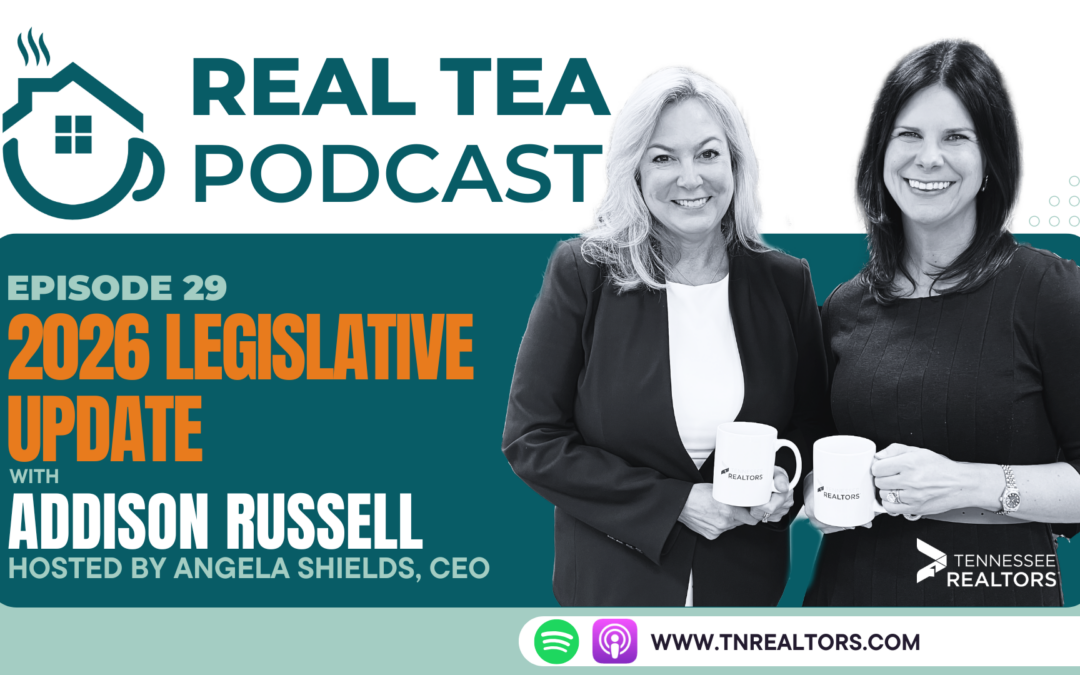
Real Tea Podcast – Season 3: Episode 2
2026 Legislative Update with Addison Russell
Tennessee REALTORS® General Counsel, Addison Russell, joins us in the Real Tea studio to give an update on the legislative session so far. We discuss the Tennessee Property Classification and Assessment bill, Vacation Lodging Services License changes, Governor Lee’s Starter Home Revolving Loan Fund and the “Yes on 2” campaign that you’ll see on the November ballots to ban state property tax.



Read
Welcome to the Real Tea Podcast, brought to you by Tennessee REALTORS® and sponsored by Rural 1st, “helping you live closer to what matters.” I’m your host, Angela Shields. This podcast is created for Tennessee REALTORS® to get the “tea” on all things real estate in Tennessee. We’ll bring you engaging conversations with esteemed guests in the real estate industry and cover a wide array of topics, including current events, governmental affairs, education, and legal updates.
Angela Shields (AS): Alright, welcome back to The Real Tea. We are excited about this episode because we have Addison Russell with us again. And Addison, I think at this point you do not need an introduction.
Addison Russell (AR): Yeah, if–if our regular listeners are listening but probably not.
AS: For those of you that might not know Addison, Addison is our attorney. She is our lobbyist. She is just basically everything, I believe.
AR: Not everything–some things. Not everything.
AS: But many of you have heard Addison and I think the funniest part is Addison’s husband is also a lobbyist with us and I think what I enjoy is whenever we get in front of our members, listening to the two of you debate who’s had the best episode and I think you can now say you’ve had the most episodes?
AR: The most, yeah.
AS: So I was looking forward to, trying to get both of you at the same time so we could really debate that out.
AR: Yeah, well, there’s opportunity for that. So he’s actually lobbying today on our behalf. So–but yeah, maybe after Session we can consider.
AS: Definitely. And speaking of Session, that’s why we’re here today–because we are in the thick of it.
AR: Yes. I think we’re at the pinnacle this week. I really–I’m hopeful it’s the pinnacle and then it’s like downhill slide after the next after the next two weeks.
AS: And something is happening it feels like every day right now.
AR: Yeah. I mean, I think I tell people like in legislative time and I know that REALTORS® can kind of relate to this because they’re they operate on timelines. But like a week at the legislature is like a month in real time and a day is like a week, and then an hour is like a day. And so people will be like, “Will you–I told you that yesterday,” and in normal speak, like an attorney world, “Okay then,” you know, “give me a few weeks” or something. But in legislative world, it’s like a day is like, “Alright, you got to have it. Figure it out.” You know, sometimes in an hour. So, a lot going on on compressed timelines, but, you know, kind of like it’s fast paced. It’s not boring anyway.
AS: Definitely not boring. So, a few weeks ago, we took a lot of REALTORS® to the Capitol and visited with our legislators. And, obviously it’s Day on the Hill for us. I think we had 3-400 members that attend that. It was a pretty big crowd–
AR: Huge crowd.
AS: –but let’s just start off right there for just a second. Tell us why that matters.
AR: I think Day on the Hill–and, you know, I think if we’re talking about maybe people that have never come kind of like what the format looks like is in many interest groups and advocacy groups do that throughout session, it’s not uncommon. But like I said, we have so many that come and they get the opportunity to meet with their legislators and talk about issues that are affecting the real estate industry or also like private property rights and their clients and their consumers and really have that face time with their legislator. And then we get to have like a reception the night before where you get more of an informal opportunity to mix with legislators.
So, like if you’re from Memphis and you come to down the Hill and you get to meet with Memphis legislators, and that’s really cool but then at the reception, maybe you get to, like, meet someone from Knoxville or in northeast Tennessee and just a more informal setting and kind of get exposed to a lot more. And I think that those receptions have been really beneficial and we’ve had really good turnout from legislators and from our members.
And then Day on the Hill, especially the turnout from members, is so incredible. And I really appreciate everyone coming and advocating for issues that affect, like I said, REALTORS® and our consumers. And that’s why that’s important though is because legislators hear from me all the time and I think that effective advocacy comes in all different formats. One of those is having a lobbyist. And then we also do like Calls to Action. But the Day on the Hill and the face-to-face with constituents and hearing real stories that they can share from their personal experience I think moves the needle so much more than if they hear from me or if they hear from Matt.
And you know, legislators know REALTORS® in their community, like they have relationships with them and they trust them. And so just having the opportunity to share from their experience makes a big difference to those legislators. And I think that that’s why that day is so important and I really appreciate all the participation that we get.
AS: It was fun this year. We gave our members the scarves to wear, and you would see the scarves all over the Capitol.
AR: And I got a lot of comments. Everyone’s like, “I like the scarves.”
AS: We actually had… I don’t think it was a legislator, I think it was somebody on their staff who stopped one of our Executive Committee members and asked how they could get one. She literally took it off her neck and handed it to her and let her have it. But we did–we get a lot of comments on those scarves.
AR: And it’s very recognizable and then I think that that goes a long way too not just showing the legislators that you met with but like other lobbyists or other people that were there also doing their thing of like, wow, this organization is really not I want to say, vocal, but like really shows up and really cares. And just kind of–you could see that impact, you know, across so many different spectrums that day.
AS: Right. Before we jump into why we were there and some of the items we talked about, there was big news that happened right after we were there. So we met with the Lieutenant Governor and it wasn’t just a few days later, he made a big announcement.
AR: And I love–Randy McNally is our Lieutenant Governor right now and he’s been such a faithful servant to the state of Tennessee. He’s had a well tenured career and I think what I really saw after he announced his retirement–you saw Democratic Caucus senators putting out the nicest statements about him and just saying, like, how much respect they felt for him like, while they were in office and how he was such a good statesman and lead with a steady hand.
And I think that that just really speaks volumes, like the kind of leader that he’s been for our state. But I am so happy for him and to–to retire and take the step back and spend time with his wife. You know, I think that that’s going to be really good for him. But yeah, that was kind of a big announcement. You know, everyone was playing the “Will he, won’t he run again?” and so to make that announcement that was very big news that happened on that last week.
AS: Right. And I can say he has always made himself available to Tennessee REALTORS®. Any time we’ve asked to visit with him, he’s usually the first that will come and speak to our group. He–he’s just been very good for us as far as just being there.
AR: Yeah, and listening and being responsive and willing to talk for sure. And then talking about down on the Hill for those that came, they got to sit in the Senate chamber where he made that announcement. And I think that’s such a cool opportunity for Tennesseans. Like, not everyone gets to sit on the Senate floor or like on a desk that a senator sits in and just to have that experience. I think, you know, we got to go and Speaker Sexton address this in the chamber but–and maybe I’m a nerd because I think that’s really cool but I just think that it’s something that not a lot of people get to do. And so if you have the opportunity, that’s when–that’s probably one big reason to come today on the Hill just for opportunities like that.
AS: I think the other thing, someone who doesn’t go maybe misses the opportunity to hear some really neat information that not is necessarily political but it’s just information about what is happening in our state.
AR: Right.
AS: He was telling us some really just insightful information about businesses and the technology and just things that you may not even know that’s taking place in our state.
AR: Yeah, I mean, Speaker Sexton talked about like, nuclear energy and how we’re really trying to position ourselves to be a nuclear energy leader. But you get to hear that of like, what that looks like on the state level of how we’re going to recruit them, how we’re going to build the infrastructure around them. And I think the housing actually plays like a big part in that kind of like, you know, Tennessee is really been trying and they’ve done a really good job at bringing industry into the state but, you know, jobs mean houses. And so like these people need somewhere to live and I think that that’s something that really it all ties into kind of like what we do on some level.
AS: 100%, 100%. So, while we’re there, we always have a few issues that we’re talking about when we’re visiting with our legislators. So, let’s talk about some of those issues that we did talk about. So, one is the VLS license changes. So, let’s let’s talk about what that let’s rewind that. Yeah. Let’s talk about first of all what is VLS.
AR: So VLS is a “Vacation Lodging Service” license and that is a license required to manage properties in the state of Tennessee for rentals that are shorter than 14-day periods. So short term rentals–how it operates now is you can be an affiliate broker or you can be a principal broker but you have to get this extra license–a VLS license if you want to manage short term rentals.
So, what we are trying to say–or with this legislation, legislation is–say if you hold an affiliate broker’s license or a principal broker’s license. You don’t need the additional licensure to manage short-term rentals. And the reasoning for that is an affiliate broker has 90 hours of free licensing education. A principal broker gets 120 hours of pre-licensing education and that, you know, obviously there’s tons of education that follows that. You have to go and take another eight hour course and pay a $90 licensing fee to manage properties that are less than 14 days when you can manage properties that are 15 days, maybe doesn’t make sense. And so by removing the duplicate licensure, we’re trying to really deregulate and streamline mostly and so that’s going really well at the legislature.
And I think it’s important to note, though, that we are maintaining the smaller license, which is the Vacation Lodging Service license. So if someone is only managing short term rentals, they can get that lower licensure and continue to operate without the supervision of a principal broker. Like, we are not changing that business model at all, just trying to kind of remove duplicate licensure because with your affiliate broker or a principal of a broker license, you know, we don’t distinguish between residential real estate, commercial real estate, property management. And so it’s really on those brokers to get the proper education when they do their CEs. So if you’re going to you know, wade into the short term rental business, obviously seek out education that’s tailored to that to learn the nuances of that but maybe you don’t need an additional licensure from the department, from the state to do that.
AS: Right, right. So, there were a few other things that we also talked about with our legislators, one is property classification and assessment. Tell me a little bit more about that and why that was important.
AR: So what we have seen in recent years across the state, particularly in three counties, that some county assessors are assessing rental properties at a commercial rate rather than the residential rate. The Constitution defines residential property as property that does not contain more than one rental unit. But there has been a shift in my mind–a shift from that constitutionality, where it’s just completely based on use.
So you could have a standalone single family home that’s being rented. Now that’s commercial property, even though someone is very much living there and it’s residential. So we are part of a coalition working to seek clarification in statute that, if it doesn’t contain more than a rental property, one rental unit and can be transferred for as simple as that unit, then it should be classified as residential regardless of whether it’s your primary residence.
And that’s so important. Because that rate really makes a difference on your property taxes. The commercial rate is 40% and then the residential rate is 25%. So that can really move the needle in what those property taxes look like.
AS: Sure. Which in the end could hurt the renters, the owners. It can it hurt everyone.
AR: For sure. And so I think Davidson County has a really neat tool, like a property tax calculator and if you go on there, these are rough numbers but you can see like like the Berry Hill neighborhood, input $500,000 as a value of the home, which is about the average price of a home in that neighborhood, and at the residential rate–taxes annually are going to be $3,800 and then at the commercial rate, they’re going to be about $5,900. So that’s a $2,100 difference but annually that cost only gets passed on to the renter. So you’re looking at about a $200 a month increase in rent, which is about a 10% increase just on taxes alone. And we all know that, like insurance isn’t going down.
And then with interest rates kind of where they are right now, carrying costs are high on properties. And so if, if we don’t control this tax rate, it’s only another expense going on to that owner and then also to the renter.
Right, right. So another thing that we’re really focused on as some of Governor Lee’s bills that he had involving housing. He had–he’s really focused on housing and affordable housing. So let’s talk about that just a little bit.
AR: So what we’ve seen from the Lee administration is he really understands that regulation increases the cost of housing. And that’s something that we preach all the time on the Hill because there’s several bills, that either increase like the fees on development or just, you know, the more time it takes to develop a property, the more cost it takes to develop a property.
So we’ve seen familiar administration where he’s done that, third party inspectors trying to speed up that process. He has legislation this year that kind of says how long local governments have to respond to plans and in an effort to speed that up. And then, he’s also has legislation that will change codes a little bit. So right now, if you’re a fourplex or smaller, your residential codes, you don’t need things like a sprinklers or stairwell–extra stairwells. And so he’s actually trying to expand that to six units, which I think will help some of the more, more urban communities really develop those at lower cost. And then what we’re really excited about and what we talked about on Day on the Hill, is the money he’s setting aside for a starter home revolving loan fund.
And so Governor Lee has proposed $30 million in his budget to go to THDA to create this revolving loan fund where builders can access loans at 0% interest rates to build starter homes. And that’s 1,200 to 1,500 square feet. So I think that that’s important because we’re trying to put more of that supply on the market. And really, just by the size of it, you’re hoping that it’s more attainable, to–to more buyers across the state, and then that builders will pass that savings that they’re getting through the 0% interest loan to the consumer in an effort to keep those more attainable.
AS: Yeah, that would be that would be huge for us.
AR: Right, I think it would be for sure. And then I’m–you know, so right now we’re lobbying to try and get it to stay in the budget so it’s not a done deal. And the legislators do have the authority to kind of amend his budget before it passes. So that’s step one. And then–but step two, if it can remain impasse, I’m really excited about see what the implementation will look like because it is statewide.
You know, it can be in your urban communities. It can mean your rural communities and it can be a smaller part of development. It’s like if a builder is developing, you know, a bigger subdivision or a bigger complex, you know, they can use some of this money for just like a smaller piece of it too. So I think it could be really, really good hopefully.
AS: Yeah. I think that would be something that would be just a huge tool for the state of Tennessee. That would be something new, would be exciting to see. But something else that I know we’re working on really hard is the property tax to to eliminate the property tax for the state so that they would not be able to, have a property tax in–in Tennessee.
I think there’s a lot of confusion when it comes to local property tax so to have you explain that one.
AR: Yeah sure, it’s Governor Lee, he’s actually the statewide chair of that “Yes on 2” initiative but Tennessee REALTORS® is a very active participant on the Yes on 2 coalition. And what we’re trying to do right now is educate voters on why it’s important. So it’s passed the General Assembly to amend their constitution. The state of Tennessee does actually have a state property tax, it’s just set at zero. But if times got tougher, you know, the state can always come in and implement a property tax, which obviously only drives up the cost of housing. So a constitutional amendment has passed the legislature that and now it’s going to go to the voters where the voters have the opportunity to say, “State of Tennessee will never have a property tax.” and then in order to get one, you’d have to go through this whole process again of amending the Constitution. But–so by putting in the Constitution, we really feel that we’re safeguarding–our state is like a lower tax state and saying we don’t have a property tax and we’re not going to have one. Similar to the initiative with the income tax a few years ago; we don’t have a state income tax and we’re not going to have one.
So I think that that’s just really–It’s really important. Again, it’s an effort to keep the cost of housing low and the ability to stay in your home more attainable, I guess. You know, especially as we have aging–an aging population that they won’t owe taxes to the state– That is so different, very different from obviously the local property tax.
Every every Tennessean is like, “Oh wait, I pay property tax.” And you do, but not to the state, you pay it to like your city or county.
AS: So in essence, if they were to ever enact a property tax for the state, it would be you would pay it twice, you would pay once to your local and then once the state.
AR: It’s on top of the property taxes that you already pay. And so I think that that’s the biggest distinction is we understand local governments. They run on property tax. Like that’s how schools are funded. That’s how your local roads are funded. But since the state isn’t relying on property tax right now, they’ve proven the ability to operate without one and so we’re going to ensure that there is never one. But that does not affect the property taxes that you pay at the local level.
AS: Right. And I think that is what, most people are trying to understand. You’re not trying to take it away from the local. It’s just not having the state ever come in and, and start collecting that money when they hadn’t in the past.
AR: Yes. Right. And there are a lot of initiatives surrounding property tax at the legislature right now, which it probably only confuses the matter more. But I think we need to be good. And then as our members and listeners talk to their clients, educating them to go vote Yes on 2 this November. And you know what that means, that that is just the state property tax.
AS: Right in this, just for an educational piece. It wasn’t easy to get this. They had to go through several votes through the–
AR: General Assembly.
AS: –General Assembly to get this forward. Yeah.
AR: So how a constitutional amendment works in Tennessee is it has to pass, one, General Assembly–and when I say General Assembly, that’s a two year session. So, every two years we reset our new General Assembly. So it has to pass the first General Assembly with just a majority vote, which is how most bills pass with a majority vote.
Then it has to go come back and pass a second General Assembly with two thirds of the vote. So it’s a higher threshold and, you know, you can’t afford to lose a lot of votes at two thirds. And then once it does that, it can then be placed on a statewide ballot. But it has to get 50-plus 1% of the people that vote for governor, like has to vote for governor.
And so that’s just like where I think we come in as advocates of keeping voters around for the question and saying, like, don’t cast your vote for governor. And then you start reading because there are a few constitutional amendments. These are inconsequential amendments, and you just get bored and walk away. It’s very important that you stay and you cast a “yes” vote.
AS: Right. So important. On the educational front, I want to go back. We were talking about the Lieutenant Governor, who when you have people step up and want that position in the future, who actually votes for that?
AR: The Senate–and so–I think Tennessee is a little unique in that sense that the Lieutenant Governor is the Speaker of the Senate, and then gets constitutionally called Lieutenant Governor. It’s not a statewide elected position in some states, I think you elect a governor–voters do, but here in Tennessee, it’s just the Speaker of the Senate.
So what will happen now is, when they come back in January, the Senate, as a body will vote on a Lieutenant Governor and majority of the Senate, however they cast their votes at that who will be your next governor. So we won’t know until January officially.
AS: It’s interesting. So as far as, where we are–so any, any outlook, any thoughts on the rest of the Legislative Session for us?
AR: Right, for us. I, you know, I said this week is kind of like the pinnacle of the week, mainly because the Senate Commerce Committee is on its final calendar and there are like 120 bills on calendar in–I read through like a 600-page amendment pack that I sent Jonathan and I was like, “Look at all these amendments.”
So there’s a lot happening this week and it’s almost I’m like a “let go and let God” kind of phase of like–we’ve, you know, we’ve laid all the groundwork we can and we’re continuing to fight this week. But there are a lot of bills that we’re amending or a lot of bills that we’re trying to stop or–and then obviously, the issues that we talked about here, that we’re really trying to get over the finish line in that property tax assessment bill is up this week on its first stop.
So I think that the next two weeks are really going to be like the meat for us and kind of seeing where we are and what all we can get done. And then–then we’ll be on the down side where I think we really focus on the budget in that $30 million fund and keeping that in. But overall, it’s just been like a really good session for us.
So we’re fortunate to have good sessions. And I think that that’s really in part to the advocacy of our members and just how great they are at responding to Calls to Action or showing up on On the Hill or, you know, our TNPCs calling their members. The amount of times that I’ve used that program, it’s just–it’s amazing and it’s so helpful to have that, like, “Hey, who is someone that we know has a relationship and then can call their cell phone?”
And so I look–I’m hopeful to have a continued good session, obviously. And then I think that the tone this year at the legislature has just been relatively calm overall, knock on wood. You know, we haven’t seen the protests that we’ve had in the past few years. It doesn’t seem like there really any big issues that everyone’s getting really worked up about.
I think the legislators are in a mindset of like, “Let’s come in, let’s do our work and let’s get back to our districts–” you know, “–and help our constituents there.” And so, I mean, that’s great. I’m here for that. So I think I think it’s good.
AS: So, I want to make sure that because you say it’s calm and all that kind of stuff, I want to make sure everybody understands what is really behind the scenes. Because when you say calm, approximately how many bills do you all go through?
AR: So about 1,200-1,300 are filed each session. So we had 1,200 last session and then you got another 1,200 this session. So we go through this. But when you’re in this part of the General Assembly, that means there are 2,500 live bills essentially. So yeah, it’s just kind of like things that you thought were gone and taken care of last year are like popping up and you’re like, “Oh, that’s still out there.”
So yeah, that’s that’s kind of what we’re doing. And then, but–and the REALTORS® follow a lot of those.
AS: Right.
AR: It’s like I said, you know, we talked earlier about how housing is tied to so much stuff, and it really is and the amount of bills that just the REALTORS® online are tracking and engaging in–it’s a lot, it’s a lot going on.
AS: And just, we touched on a few that are the top priorities but what are some topics that like–the trigger for you to look at things? Because when you say calm, I think, I think that makes it sound like, “Oh, there’s not a lot going on,” you know? There’s plenty–there is a lot going on and I think it’s important everybody understands that. You all are so busy.
AR: Yeah, it may be calm with legislature but not calm in my mind, ever. The things that I look for when going through bills–obviously property, I mean, anything that says property, that’s a key. And then, fees, taxes, regulations, all of that stuff. And I said property tax is just a really hot issue right now so we’re filing a lot of property tax issues. You see anything related to housing and then stuff that you like may not even think of. Actually, [Tennessee REALTORS® Governmental Affairs Director] Jonathan this year was like, “Hey, we need to be following all these data center bills.” Like, “Oh yeah, like we do,” but that just maybe wasn’t on my radar when I was going through them.
It’s like, okay, but that affects our commercial brokers so much. And so it’s just like all these things that kind of pop up. And then wastewater is a really big one. And there are a lot of issues surrounding that in kind of like sewer and all of that stuff that really affects, you know, the development of neighborhoods and utility regulation.
So it’s a lot.
AS: A lot. Yeah. Yeah. And I know, even AI, I mean, there’s just so much that we are constantly talking about.
AR: Yeah. And like you mentioned AI and obviously that’s a hot topic. But like obviously our members use AI in their practice. And so it’s a balancing act of the legislature being like, not all AI is bad, and then how are you going to regulate it? Like, we don’t want to cut ourselves off at the knees on like these tools that can help us serve our member or serve our clients. So just kind of looking at that.
AS: Also could harm us on the other side. So it’s like where where’s the balance?
AR: Yeah, there are plenty of days I’m thankful to not be a legislator.
AS: Yeah.
AR: Issues like that, I’m like, “Okay, good.”
AS: Be on the side, that’s for sure. Right. Well, y’all are doing a fabulous job for us and we do appreciate it very much. And then on top of it, you have the legal side. So I don’t know how you do everything you do but we do appreciate it very much.
AR: I’m happy to do it. I’m grateful to do it. Thank you.
AS: Any, any final words that–
AR: No final words. I mean, I do just want to continue–I know I’ve said it here but the involvement from our members just makes such a big difference that they care. And, you know, I think what kind of sets REALTORS® apart is: A.) The volume and how much we care. But then also, like most of the issues we talked about today aren’t self-serving to REALTORS®, like, you know, that we’re really advocating for consumers and private property rights. And I think that that’s different than a lot of other organizations that you see. And I think that makes a difference when you come in and you’re not coming from like a self-serving standpoint.
AS: Or a partisan side, really.
AR: Yeah, we are definitely not a partisan group. You’re right, like it’s just things like that kind of make a difference where you’re not–they view you in this lane and only this lane.
AS: Right, right, I agree but I do I think that you make a good point about the importance of the members staying involved–in paying attention. We often say that their job is to sell real estate and they wouldn’t have time to do what you’re doing and to continue to sell real estate. And that’s why it is so important that this is their member benefit, that you are the insurance, that the advocacy is insurance but it is important that they are a voice when called upon to actually activate that voice.
AR: Yeah, I mean, if they don’t care, like I can’t make them care, right? But they do, they care and they’re engaged and it makes my job easier. And I think it makes–that’s more impactful.
AS: Yeah and to me, that’s also on the local level, when their local GAD or local association is saying we need somebody at City Hall or at the national level when we have a federal issue going on. It’s it’s all three levels. It’s so important.
AR: Definitely, and then I think that at the local level, particularly the things that they can stop or be involved in there before it becomes like a state issue or like a larger issue–I think that that’s so important to have that advocacy there because it can just, you know, before it gets bigger, they can handle it with people they know and the people that they’re close with to.
AS: 100%. Well, again, thank you so much for for sharing. I know that you need to probably get back over to the Capitol today because it is an important day and an important week. And we appreciate you taking the time to coming in and talking to us and I know we’re going to call you back so that maybe you and Matt can come together. And then if not, we’ll definitely have you back in to give us a wrap up on what has happened for the year.
AR: Yeah, let’s do that for sure.
AS: Well, thank you.
AR: Thank you.
–––
Thank you all for joining us today on The Real Tea Podcast. If you enjoyed this episode, please share it with your friends and colleagues. Then visit tnrealtors.com to submit your questions and topics for future episodes of The Real Tea Podcast. Thanks for listening.