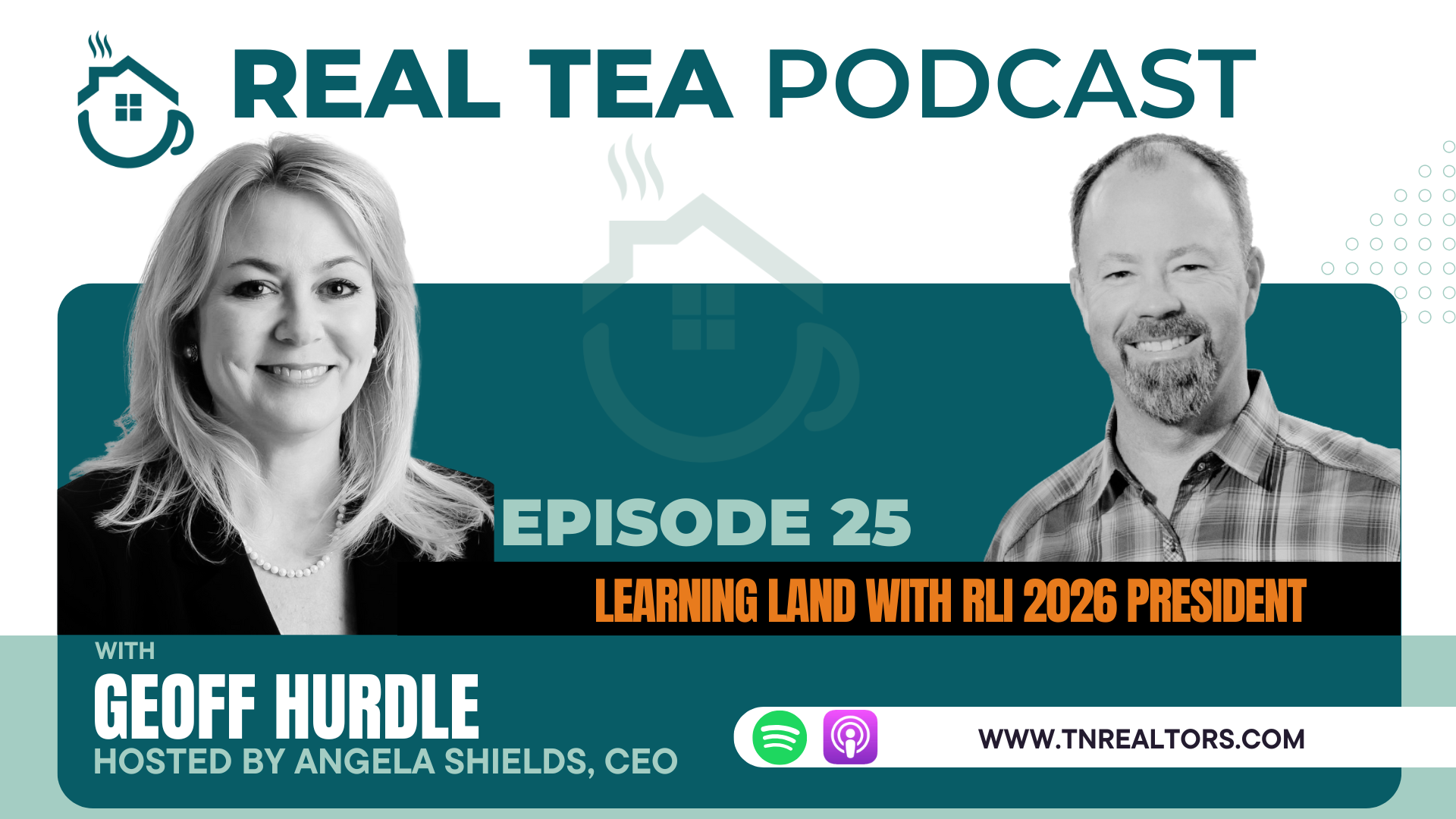
Learning Land with RLI 2026 President
REALTORS® Land Institute 2026 President and Tennessee REALTORS® member, Geoff Hurdle, sits down with us to spill the tea on all things land. He talks about land education and opportunities, 2025 accomplishments, and shares some… mmmmm… interesting stories about being out in the land.



Read
Welcome to the Real Tea Podcast brought to you by Tennessee REALTORS® and sponsored by Rural 1st, “helping you live closer to what matters.” I’m your host, Angela Shields. This podcast is created for Tennessee realtors to get the “tea” on all things real estate in Tennessee. We’ll bring you engaging conversations with esteemed guests in the real estate industry and cover a wide array of topics including current events, governmental affairs, education and legal updates.
Angela Shields (AS): We are very excited today to have a special guest with us on the Real Tea Podcast and that guest is Geoff Hurdle who will be serving as the 2026 RLI REALTORS® Land Institute President. So Geoff, welcome to the Real Tea.
Geoff Hurdle (GH): Thank you, Angela. I appreciate you having me.
AS: We are excited. Now, before we kick off and start talking everything to do about the sale of land and the REALTORS® Land Institute, I have a special question for you. We ask every guest this question. We’re called the Real Tea Podcast. So, I want to know, what do you take in your teacup?
GH: Nothing. Well, if I drink tea, just tea. Otherwise, it’s coffee.
AS: Well, a lot of people say that to me. They don’t drink tea, they drink coffee instead. So, that’s perfectly acceptable.
GH: But if I drink tea, it’ll just be whatever’s brewed. I don’t add anything to it.
AS: Well, a lot of people are like that. I have even had some who are like, “Hey, we’re in the South. I’m going to have sweet tea and not have hot tea.”
GH: So, that’s understandable. That’s a good answer as well.
AS: Totally get it. So, let’s talk about the REALTORS® Land Institute. We may have some that are not familiar with what the REALTORS® Land Institute does. So, in a nutshell, can you share what that organization is?
GH: I sure will. We are one of the commercial affiliates for NAR, or N-A-R I’m supposed to say. We are all things land. All types of land: farms, ranches, timbers, vineyards, transitional development, land management, auctions, appraisals… everything that has to do with the land. That’s what we do. We serve agents, brokers, land owners… We provide educational resources, networking opportunities. We actually bestow the Accredited Land Consultant–ALC designation–through RLI. So that’s pretty much us in a nutshell.
AS: And there’s a lot to learn when it comes to specializing in land just like there is when you specialize in commercial or any other specialty. And I think a lot of people don’t realize that. So, I’m I’m very excited to talk about everything that you can learn when it comes to land and why you really should consider getting a designation or joining a group like RLI so you can stay up-to-date on those types of issues and not necessarily think just because you sell real estate, you sell residential that you can just go out to a tract of land and think that that’s just easy to sell.
So yeah, let’s let’s dive into that just a little bit because um what what’s the difference? What are some of the things that you would really need to specialize in and understand?
GH: Wow, you’re going in deep right out of the gate. Article 11!
AS: That’s right.
GH: I believe in Article 11. In fact, just this morning, I’ve got a condo in Chattanooga and I put it on the market and I’m not doing it because I don’t know anything. I’ve been in business 34 years and I’ve never sold a house. This–I’m a land guy and I stick to it. So, I hired a local agent to sell my condo and I’ve hired agents in the past to to sell houses. So, you’ve got, I mean, zonings, you have residential, you’ve got then you got commercial, which you have–I mean under everything is the land. So, all the zonings pertain to us. So, you have to know that–soils, you need to know stuff about sewer and sewer locations. You need to know–I mean, it’s endless, Angela. I mean, I could go on for hours about what you need to know. What you need to know is a good land agent. If you’re not going to practice land and/or learn about it, we have educational and transitional land. We have farm and ranch land. We have commercial land. We land development courses we offer. There’s a lot to learn. A whole lot.
AS: It’s amazing. Yeah, it’s amazing. I even know from my time in Texas, there’s mineral rights that come with land. And when we say–I do want to go back and make this clear, when we say that you’re serving as president, you’re not serving for Tennessee–you’re serving for the whole entire nation, for the whole country, you’ll be serving. So, that’s a lot of people you will represent. How many people are members of RLI?
GH: We’re right around the 2,000 mark aand we have about 750 ALC designees and we are–we are small but mighty. We’ve had–our top–we had 20 I’m not going to get the numbers out exactly right but last year at our awards program we had 255 applicants and those 255, 55 applicants sold over $9 billion worth of land real estate in 2024.
AS: Wow, that’s amazing.
GH: Yes but we do–we do cover every every bit of the land.
AS: That is definitely amazing. And so when you join RLI, what are some of the benefits that come with being a member of an organization like RLI?
GH: Oh, well, our education is top tier. If you need to learn it in the land industry, we offer it. And we have I think it’s 11 courses right now and constantly being updated. In fact, we’ve updated our land investment analysis class last year. We’re in the middle of updating our “Land 101” course, which is like your introductory course to land. And also about to start up our transitional land, which is in a nutshell any land that needs to be rezoned to do what you plan on doing with it. So, education is one. Collaboration with one another different peers across the country learning from them–I’m constant constantly learning. I don’t–no one I don’t think in this business knows it all and don’t have a reason to know it all necessarily.
You mentioned water rights earlier. You know we don’t deal with that in the southeast. But you go to Colorado–and I was out there with a member once and he was kind of showing me his pivot irrigation system and explaining to me about the water rights and right over my head ’cause I’d never heard of it. But there’s there’s battles about that but the best thing about it is, is the camaraderie and and the relationships that you build with other members inside RLI.
We have–I’ve done deals that I would not have done if it were not for my membership. I guess you’ll have this in the residential side but we have what we call a “haves and want” session. We can have them anywhere. We’ll have them at dinner. We’ll have them at conference. We can have them at a bar. We had one in a van. We were headed to the Southeastern Land Conference in South Georgia a few years ago. There were seven of us that met at the Atlanta airport to rent a van and ride down together. We did a halves and wants in the van going down and I ended up buying a place that came up through there. It was in Sweetwater, Tennessee. I developed it and sold it and then did another one with an agent in the car a few months later. So, that’s that’s the number one thing as far as your business goes is having the relationships you can have with one another in the land business.
AS: Is there classes that if someone was just interested in learning about land that maybe they’re not a member but they want to get started, can they take classes?
GH: Absolutely. Don’t need to be a member. We encourage you to be a member and of course that’s one of my biggest jobs is just to recruit membership. But yes, our classes are open. You can take them. I would again–I would start off with “Land 101.” It–they’re offered all over the place. We have them online live. We have them live in–in class sessions with you know, instructors in front of you. We have these… they call the online ones that are live “virtual online training courses,” I think they call it. And then we have some a few of them you can learn on your own pace. I’d recommend doing it in person with an instructor with other people around you ’cause the questions and the bannering back and forth, at least for me, help a lot.
AS: So, Geoff, how did you become interested in land sales and end up making that your specialty?
GH: Oh, that’s an easy one. I’m the grandson of a farmer and the son of a developer. So, the landside was pretty easy to get into. It’s all I’d ever been around. And so I went to college–well, dad told me I had to go to college. He said, “That’s not a choice.” I told him what I wanted to do. He knew what I wanted to do and he’s like, “I understand that. When you get out of college, you can go.” So, I did. I went to college, got my license the year I got out and started selling. I worked with him as a developer and sold the tracts here and there, whatever I could and that was 1992–so, what–34 years ago about?
AS: So, that’s exciting.
GH: Well, actually, that’s not really exciting. That’s kind of boring.
AS: No, it’s exciting!
GH: No, I–I didn’t have some crazy story to share. It’s just I wanted to do it and I started it and I stuck with it.
AS: It’s exciting that you’ve been able to make your career on land sales and make that your passion to be able to not only make that where you’ve made your living but also made your leadership path and and look at you here on the national level taking on that role.
GH: Well, I am. RLI had a lot to do with me still being in it though. I’m sure it’s a question coming up, so I’ll go ahead and answer it because everybody asks is, “How did I find RLI or why did I join RLI?”
AS: It’s a great question.
GH: Um, I say it like it’s a joke, but it it’s not. I was online researching something and I came across their website and I looked at it real quick and hit the “join” button, paid my dues and went on about what I was researching and kind of forgot I joined until I started getting emails from them. And–and then after that I got this thing we call an e-property and that’s where if you’re a member you can, you know, load up a listing you’ve got and it’ll go to all the different members that want to see listings from that state and they started coming through and in droves and I realized I was signed up for all 50 states.
So I turned that off and got back just to Georgia, Tennessee and Alabama and I had one come up that–and I thought looked interesting and I called the fella and I hadn’t been a member 2 weeks and he and I started talking and I liked it. I ended up buying it and developing it and got him to sell them for me and he did. So that was I mean that just got me fired back up. I was almost ready to hang it up in 2018. I was tired and it had just gone on long enough. We had–COVID was about to kick in or had already kicked in maybe and I had been in it a long time but that I joined RLI then I started getting more emails and went to Land Conference that year which happened to be in Nashville. At the time I lived in Lebanon so I was just down the street. So I went and it fired me up and here it is, what seven years later and I’m President.
So that’s kind of how I found it and it and–but it did keep me. I don’t know what I was going to do if I got out of it but I’m glad I stay stayed in.
AS: Well, we’re glad you stayed as well. Let’s change our focus for just a little bit. We’ve talked about networking. You’ve talked about education but one of the key pieces I believe the organization does and does well is their legislative piece. I know we’ve partnered with RLI here in Tennessee with some of the issues that they have really honed in on having to do with land. Can you talk about that just a little bit?
GH: Yeah, and we thank you Tennessee Association of REALTORS® for that partnership because that was the open fields doctrine.
AS: Yeah.
GH: We had filed a “friends of the court” brief with you, um, gosh that was 2024, so it wasn’t that long ago.
And because of that you know it was a case we won one of several we won and that one because of you know Tennesseans are now protected in warrantless intrusions on their private land in land that’s put to actual use. Tennessee now deems that unconstitutional and before it wasn’t. Do you want me to go in about what that was or–?
AS: Oh, you’re welcome to.
GH: Okay. They had this–the state of Tennessee had set up some cameras on someone’s private property in–in search of I guess poaching and had not asked permission, not said anything about doing it, just did it in in the secret of the night. Hung them in trees. And the story was is Tennessee came in, knocked on his front door, came in little dinnertime and arrested him and took him to jail for violation of what they–I guess assume would be poaching and he of course fought that and it went all the way up to to the state level and that’s when we became partners with you and–and won that case. I mean it was a horrible intrusion of private property rights and so that was that was the–the case. But we fight things with WOTUS, the Waters of the United States, the Bureau of Land Management issues out west. We do have you know BLM land. So yeah, we’re–we’re always–we have Russell Riggs. Russell is a Senior Policy Representative in the Advocacy Department at NAR and I’m sure you know Russell.
AS: Yes.
GH: He–he is–he fights in the energy sectors, environment, land use, property rights, visas, natural resources. He’s the everything and he’s been with us 25 years. Well, been with them 25 years, but he–he’s he’s our direct connect and without his heavy work, and then our work and our work with you, and all combined, we were pretty powerful on the Hill I’d like to say.
AS: Yeah. I think it’s another example of issues that NAR does work on and protects private property rights that a lot of times members are unaware that these types of things are happening for the consumers and for property owners that–we really do make a difference.
GH: Oh yeah, we do. And we can’t I mean you can’t get across everything to every member. They just have to know that we’re out there. We’re working it and we–we are certainly there for–for their best interests–all buyers, all sellers.
AS: Right and if we weren’t there I don’t know who would be if–if we weren’t there to be able to help in these issues I–I really don’t know who would be there to protect their interest.
GH: Yeah. There wouldn’t be anyone.
AS: Yeah, I agree. So thinking about you stepping into this new role, what are some of the trends that you’re starting to see and what are the some of the things you’re you’re planning to focus on?
GH: Oh my. Well, I mean, I won’t say I’m going in empty. I do have a a small list of things–quality sustainable growth with the membership. I don’t want to recruit members just to have a member number on a list. We want people who are going to participate, who are going to are going to be land agents and who are going to help promote the industry and with that with our current membership, I’m trying to, you know, like all organizations fight the apathy. We have members who don’t show up who who continue to be members and are in the land business but they’re just not getting involved and I think if they’re not getting all they need to get out of RLI, they’re not going to get involved. We’re about to kick off an environmental survey and and do some market research and and create a new 3 to 5 year strategic plan for ROI. And that’s actually starting–I’ll probably start getting the phone calls for meetings this month and that’s exciting to take a look at just a deep dive into into the real estate industry.
And as always, education is a constant. We will always be in continuing to improve our courses and adding new ones. And most of our classes uh especially in Tennessee, I can tell you they’re all approved for CE. There’s a little pitch. Come take our classes. But some of them are 8 16 and 24 hours long. Uh you know the LIA class is 24 hours takes 3 days from 9 to 5 to get that in. It solves all your education requirements but it’s a beast. But we’re going to start adding some shorter three-hour courses for CE work as well. So, that’s kind of where my mind is headed then for 2026.
AS: Well, those are great. And as you look back, what are some of the accomplishments that have occurred over 2025?
GH: Oh, wow. Well the stuff the–the cases we work with NAR–the open fields doctrine and the WOTUS cases and the different amicus briefs we’ve done those are all, you know, big, big wins for us. We did finish our RLI advocacy manual. We have a policy manual now in writing that outlines our 15 positions on different issues in the real estate and it’s guided you know by our four pillars which uh property private property rights, reducing regulatory burdens, preserving beneficial tax structures, and encouraging property and economic development. Um that was a that was a big win to get that completed last year.
AS: That’s great. If someone were interested in following along and learning more about RLI, how would they do so?
GH: rliland.com is our website and if they go to rliland.com, most any question they want to answer they could find on there but they can they can reach out to me–reach out to–well, I won’t put anybody else in that position–they can reach out to me. I’m easily located online.
AS: I know that I personally follow RLI on social media and a lot of good information comes out on whether it’s Facebook or LinkedIn… they do a great job of of keeping really good information out there. So I would also recommend that.
GH: Absolutely.
AS: Yeah. So, back to a personal question. I’m going to put you on the spot a little bit. What’s just a crazy–without giving a property away, what’s a crazy encounter you’ve had when it comes to dealing with land?
GH: Most of mine are zoning cases that are crazy. I’ve been, you know, stuck in the mud and on a side-by-side with clients. We’ve had to hike out. I mean, that’s you really get to know your client on those kind of days. Run across snakes that people didn’t want to cross, pouring down rain… I mean there’s just in the land business, you know, that there’s an umbrella do you a whole lot of good in the in the woods. So usually just go out with boots and you just get what you get. Um, okay. Here’s I’m not sure how crazy you want to get with this, but showing a property to a client about–gosh, this was 20 years ago, maybe–it was winter and we no side-by-side, so we’re just leaving the truck. We walk out through the woods and we’re just going all through it. And the next day, uh, they called me up and asked me how I felt. I said, “I feel fine.” Well, we had walked through or at least they did apparently some poison ivy.
AS: Oh, no.
GH: And the vines that, you know, it was it was off season for it, but the oil’s still there in the vines and they had gotten it all over and they had had to relieve themselves while they were in the woods. So, it was everywhere.
AS: Oh, no.
GH: Crazy. Um, but like I said, most of my most of my craziness comes in zoning cases. I had one in Lebanon and it took us–and something people not in the land business don’t realize, they don’t always happen quick like a house. This one deal took 36 months to get from contract to close.
AS: Oh goodness.
GH: Because of different zoning issues and fights and reapplications and all that. So that was–I felt like I lived with that one for a while.
AS: My goodness. That that sounds very much like a commercial property.
GH: Oh yes.
AS: Yeah. Kind of tracking the same time distance. Well, I’m going to turn to something near and dear to your heart because I know this about you personally. I know that when Hurricane Katrina happened that–not Katrina, I’m sorry–Hurricane Helen happened that you immediately jumped into action and started everything that you could do to get supplies out to Tennessee and to North Carolina. And I want to personally say thank you but I also want to give you an opportunity to if there’s anything you would like to say about what REALTORS® can do when those types of things happen or get involved–I know you weren’t expecting me to say that. You probably don’t want the recognition but I do know how much that you did and I think it’s worth talking about for a minute.
GH: Sure. Um well, thank you. But yeah, Helen hit close to home for me. I went to school in western North Carolina–actually in Banner Elk to Lees-McRae College and that was one of the hardest hit areas and least reported areas. I have friends that still live there and we was actually hit homecoming weekend. So, we had already had booked a place up there when it hit and we went anyway and we, you know, tried to see what we could do. They actually let us up is what we were surprised about the most and got to work and saw the need and came back and of course, I called Carol at the Chattanooga Association of REALTORS® and we started filling a trailer and a friend of mine, another land and housing guy, Geoff Ramsey. We started filling up trailers and and taking them up and Leigh Brown out of North Carolina contacted us. Actually, Geoff knew Leigh so she contacted us and we were radioing back and forth over the mountains, who needs what and trying to get things lined up and ended up doing I think between Geoff and I together, probably about eight or nine trips coming up to to western North Carolina and East Tennessee.
And to get involved, do what the REALTORS® did before. I mean, they came through strong. Our association offices all over were gathering supplies and someone would take them up if that someone just happened to be me and and Geoff in Chattanooga. I don’t know. You just–I don’t know why anyone would see the need in something like that and that kind of destruction and not if they had the time and the capabilities just to go ahead and help.
AS: Yeah. I often say that REALTORS® are the heart of the community and and they are the first to respond in many cases and a lot of people don’t even realize that. You in my opinion are one of the unsung heroes that a lot of people don’t even you you didn’t necessarily look for the recognition. So, a lot of people don’t even realize all that you did, but many of us did see it. And and again, I want to say thank you and appreciate all that you did. And just–it’s amazing how much you did do. And so, thank you so much for that. And I know it meant a lot to the community but I know how much it did pull at your heartstrings because I did know that was your homeown and wanted to give you a moment to at least talk about that. I hope that they are on the road to recovery at this point.
GH: It’s a long road but they’re certainly in a better position than they were. But there are areas that I knew and physically they’ll never be the way they were. Some of the mudslides that slid all the way down to to the granite below it and the soil’s gone. So, it won’t it won’t be back the way it was. It’ll be the new normal and it’ll grow from there. But they are tough, tough people. They’re going to make it.
AS: Yeah. Yeah. Well, they’ll definitely remain in our prayers.
GH: Thank you.
AS: So, as we wrap up, Geoff, is there anything that you would recommend or some advice that you would give to somebody who might be thinking about a career path that leads them down the road of land sales?
GH: Um, yeah, education. Get educated on it. One, it’s not as brisk as the housing sales from what I gather. I see people, you know, I’ve got nine closings this month. I had three last week. I got two today. It doesn’t happen in the land business all that often and I guess it depends on what land you’re in. Mainly my focus is residential development tracks because I’m the son of a developer and a developer myself. And so those certainly don’t happen all that often, but when you have a land closing, generally it’s a good day for your business. So, work hard, stay diligent, focus, don’t give up. And there’s nothing wrong with if you know how to sell houses. I don’t we have plenty of people in ROI that also sell houses. They’ve learned both sides of the market and they can do that. So, there’s nothing wrong with selling houses and being a member of RLI. And sometimes those houses help fill in the gaps. Unfortunately, I never learned it. So, there’s that.
AS: Well, that’s great. Well, we will put the information for RLI in our notes on the podcast. And in the meantime, we look forward to your installation at the national meetings and wish you the best in 2026.
GH: Thank you. I do want to do a quick plug. I’d feel bad if I didn’t. Again, don’t have to be a member to attend but in March, the 20th annual National Land Conference will be held in San Antonio.
AS: Ooh.
GH: That is where we had our first Land Conference 20 years ago. It’ll be at the Grand Hyatt on the Riverwalk and it is absolutely the best conference I’ve ever attended. I will never miss the National Land Conference. It was spectac–always has been spectacular. It’s going to be a big time. We’ve got some new changes and things coming up this year. We have the cowboy auction for our land education foundation fundraising. We have the just–it’s just a really good time. And if you really want to learn this business, attend that.
AS: What a fun city. And how many days is the conference?
GH: It’s three days. I should know the dates by heart, it is March–I think it’s 14th, 15th, and 16th. But it’s on it’s on our website. rliland.com under “Events.” So it’s a link on how you can you can start reading up on it. Registration just opened up yesterday for that so I urge you to come and be a part of it. And that’s also open–you know, we have surveyors, engineers, soil scientists, anyone associated with the land or wants to learn about it. I highly–
AS: Sounds great, sounds great. We will include that in our notes as well.
GH: All right.
AS: So again, thank you for joining us. I think we got a lot of great information.
GH: Well, thank you for having me, Angela.
AS: Absolutely. And we’ll see you soon.
GH: Okay. Thank you.
AS: All right. Thank you.
GH: Bye-bye.
–––
Thank you all for joining us today on the Real Tea Podcast. If you enjoyed this episode, please share it with your friends and colleagues. Then visit tnrealtors.com to submit your questions and topics for future episodes of the Real Tea Podcast. Thanks for listening.
Learn more about the REALTORS® Land Institute (RLI) here.