Real Tea Podcast – Season 2: Episode 18
The Importance of RPAC & Advocacy
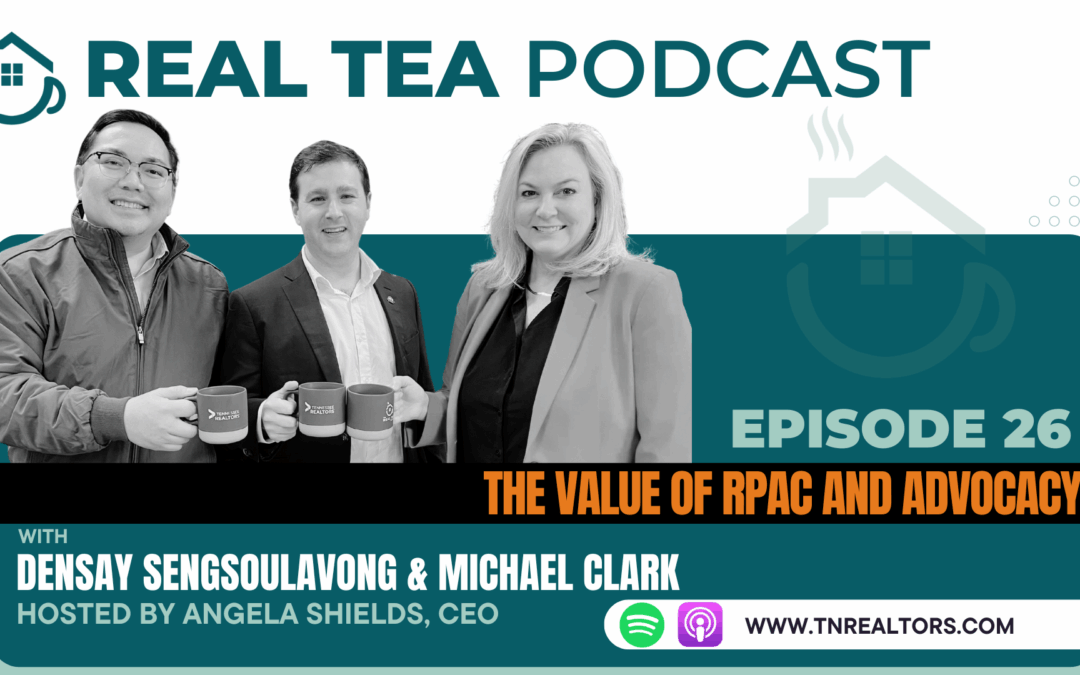
Two team members from NAR join the Real Tea Podcast to talk about all things RPAC and Advocacy. We welcome Densay Sengsoulavong, NAR’s Senior Political Representative, and Michael Clark, NAR’s Director of RPAC Fundraising and Events to the studio for an in-depth conversation. We talked about the Federal Political Coordinator program, how to select REALTOR® Champions, fundraising goals, and how RPAC brings value to our members.



Read
Densay Sengsoulavong (DS): Hello.
AS: And then we have Michael Clark, Director of RPAC Fundraising and Events at NAR.
Michael Clark (MC): Hi.
AS: So, before we get started, the reason that you’re here to talk about all things RPAC. But, before we get started, I have a special tradition that we are going to start with. We are called the Real Tea. So I like to ask all of my guests, what do you take in your teacup?
MC: Oh, it’s a good question. Do you want to start?
DS: Lemon.
AS: Just lemon?
DS: Depends on the tea, though.
AS: So, you do drink tea? That’s the question.
DS: So, if it’s Earl Grey, some lemon. But if it’s any it’s stronger like black tea, it’s milk.
MC: Okay.
DS: Yeah.
MC: I typically just don’t put anything in it but tea. But if I do, it’s going to be honey. I think usually maybe a little milk if it’s like a black tea. Yeah.
DS: Okay.
AS: Morning or night?
MC: Oh, morning usually.
DS: Both.
AS: Both? So, you like tea?
DS: I love tea. Yeah.
MC: I at night I prefer bourbon. But yeah.
AS: That’s what I was getting at, in your teacup. So, we get some who are—they prefer their coffees. They don’t want tea. And then I get the ones who are like no coffee, no tea, and they want their bourbons or whatever their special drink is.
MC: That’s right.
AS: Yeah, we—we get to the truth. Investigative reporting here.
MC: ; For anyone that knows I can figure out what I drink at night. So yeah.
AS: All right, initiation over. So thank you both. What I was saying to another guest that it is so special when we can have somebody from NAR here and now I have two special guests. So this is very exciting to be able to have both of you here. So, thank you both for being here.
DS: We often do come as a package. Like it’s—it’s like the Michael and Dense road show. We do this in other states, too. And it’s it’s always a lot of fun. And we’ve done it long enough now to where we can sort of just riff off each other.
MC: There’s a schtick. But I—but I think we love these opportunities. We don’t get a chance to come out and do this type of thing that often. And you know, being here with all of you this week has been really, I think, special and important for both of us because it’s really where we hear and learn a lot about what’s actually happening out in the country and it brings gives us the information we can bring back to actually improve programs and you know, deliver better services to members.
AS: Well, I think it’s important that members have the opportunity to visit with NAR but the team at NAR, right? So that they can put the face with the name. And our members have really enjoyed each time you’ve visited Tennessee because they’ve gotten to know you and when they see you when they go to conference, you all are so personable and they love talking and and visiting and feeling like they’ve really gotten to know you. So, it’s really special.
MC: We—we love working with them and and in particular the ones that I get to work with the most on the RPAC committees at at you know the national level. I mean, you have fantastic members in the state who work so, so hard money for RPAC and to help us with our advocacy goals all the time.
AS: They do.
DS: And you’ve got some really dedicated Federal Political Coordinators, FPCs, assigned to these members of Congress. And, I think the good thing about them being able to see us as often as they do, it makes them more comfortable when they have to ask us for something.
MC: Right.
DS: Like they—they know to come to us whether or not it’s something that is related to what we do specifically, but at least if they need a resource, they know they can come to us and we’ll find the answer for them. So, it’s been a lot of like growth since I’ve started at least, but I—I think it’s been a very enjoyable experience working with all of them.
MC: It’s probably the best part of the job is actually working with the members, right? It’s it’s getting out and actually learning why people are here and what motivates them and and getting to actually be in the trenches and accomplish big things with them.
AS: Yes.
MC: Let them lead in that way. I mean, it’s it’s amazing what our members, especially the ones who are active on committees and in associations, actually like what they accomplish.
AS: Yes, I agree 100%. And you really help paint that picture because we’re constantly telling them that just like your local association is your association. We tell them the state association is your association and the national association is your association. And so when they can develop those relationships like you just described, it really kind of brings that picture to fruition. It makes them understand and see it. So it does, it matters. I—I again, thank you very much for for being here and being that way.
MC: We will come to Nashville anytime.
AS: Okay, I’ll take you up on that.
MC: Anytime.
AS: I will take you up on that. We have lots of events, so we’ll just bring you on down.
MC: Sounds great, sounds great.
AS: Okay, so let’s let’s kind of jump in. So, we’re going to talk about RPAC. And I’m going to tell you, we hear a lot of questions about RPAC. Not so much we’ll talk about like what RPAC is obviously for the people who may not understand it, but really the questions today with everything going on in our industry is why RPAC is really important. Why should I keep giving to RPAC or investing in RPAC? All of those things.
So this is a great opportunity to really talk about it because advocacy in RPAC is such an important value and a great opportunity to participate and to get involved. And so I think being able to unpack that and have that conversation is so important. So I want to just kind of open that up and let’s just start with let’s explain what RPAC does.
MC: Definitely. Well, I mean RPAC is really the engine that fuels every single thing that we do in advocacy. You know, we oftentimes try to describe it as, you know, it’s a—it’s an entity. It’s a political action committee. I mean, just to answer the original question, uh, which means that it gets to take member dollars as they invest voluntarily in into the political action committee and then spend those dollars on issue advocacy, but also in supporting candidates. And a lot of what Densay does and he’ll talk about is how we actually support candidates and and invest directly in them. But at the core of what it is, it is what it helps us protect what’s possible for our members and their businesses for their clients.
And you know, if you think about first-time home buyers or veterans trying to buy homes, think about the possibility of wealth generation. That’s what RPAC does because it helps us establish relationships with elected officials and policy makers at every level of government.
And I think one thing that people sometimes don’t know about RPAC and it’s—it’s really the most amazing thing. It is not only the largest political action committee, but it’s also the largest got the largest footprint because we’re federated at all three levels. We have a local RPAC, a state RPAC and a national RPAC. And so when decisions are made, it’s critical that REALTORS® are in the room. And if we don’t have a seat at that table, if we don’t have the opportunity to advocate before decisions actually do get made and educate those people who are in positions to affect policy, to affect people’s bottom lines and their businesses um and our communities as a whole, uh then we’re then we’re we you know, we’re failing. We need to be in the room. And that’s the great thing about our pack is it gets us in the room. Um we have to be there every single time. we are as a result of our members investments and as a result of um as a result of their their ability to build relationships with those candidates. And I think we know that nobody builds relationships better than REALTORS®.
AS: That’s like their business.
MC: It’s their business. They are in the relationship business. And so for us, you know, having them be invested in it and especially having 500,000 of them across the country invest in it not only shows the strength of this industry, of these organizations and these associations, but it also has a real impact on how policy makers and legislators think about REALTOR® issues and how they respond when REALTORS® show up in their offices. And so it helps get get us in the door, but it makes sure that we have a consistent seat at that table when decisions are made.
AS: Right. Right.
DS:Yeah, and—and building on those relationships, the FPCs are are charged with sort of leading that with their members of Congress, right? And because REALTORS® come from all facets of life, we have a large association, the FPCs also come from different backgrounds. Some are very politically inclined and already involved and they know who the member of Congress is and some might need help building that relationship. Our PAC does that. It does that by allowing that FPC to use RPAC funds to attend in-state, in-district events for their members of Congress so that they can have some face time with them, get in front of them, get to know them, and ultimately become a resource for that member of Congress when it it comes to all things real estate. And so it it also helps the lobbying team too because they do the same thing with the member of Congress in D.C. So, and—and RPAC allows them to to build and maintain that relationship.
MC: And I think, you know, one of the questions that we often times get and I and I think you almost kind of hinted at this is, well, why is this even necessary?
AS: Right.
MC: And it’s necessary because for better or for worse, our political system in America relies on contributions. Campaigns right now, 2025, they are more expensive than they’ve ever been. You know, the last presidential race cost billions of dollars on both sides. And so the way that we can build those relationships is by demonstrating support and showing allyship and actually helping those individuals get elected. And unfortunately sometimes the best way to get elected is by having the most money in your campaign account. And so it helps us get in the door by helping them stay in office or get elected to office and reminds them that we were a critical part of your election strategy that you can’t forget about us. That we we should be the first people you call when there’s a housing question or when there’s, you know, any other question related to the issues. And obviously we have such a broad legislative agenda. Um but call us cuz we want to tell you what we think and what our members think about this.
AS: Right. And we—with private property rights you have so many experts that you have what 1.5 million members that somewhere along that way you have that expert who can help with that issue. So it it is such a huge resource. And then not to mention all the tools that you have available from RPR to Dr. Lawrence Yun to Jessica to I mean all of it. You just have so many resources available to help.
DS: When it comes to affecting public policy, the —he REALTOR® member is—.
MC: Without a doubt.
DS: You all are the ones the REALTORS® are the ones everyday practitioners.
AS: Right.
DS: We’re the ones in the trenches doing all this work. And so often we, you know, we could be in—in D.C. developing policy, developing a legislative agenda, but if it’s not achieving what the members need day-to-day, then we need to, you know, make some shifts.
MC: Well, let’s be honest, like they’re members are the best ambassadors for this cause and for the issues that we support because they live in the communities that these individual members of Congress or state legislators represent. They are their constituents talking about issues that impact them, their families, their livelihoods, their clients, you name it.
And so it’s a lot more impactful, frankly, when numbers show up on the Hill uh because they’re talking about how this actually where the rubber meets the road and how these policy decisions will personally impact them and their businesses.
AS: But I think you mentioned in the beginning, I’m gonna kind of go back to that. You—you talked about—you touched on the fact that it’s member driven. So a lot of the policies that you all work on come from these committees that NAR forms and we talk about it all the time that members that want to talk about what they think about NAR should be doing or state should be doing or their local should be doing. That’s why you volunteer so that you can have a voice and participate in these committees and—and actually get involved and—and have a say in these policies.
MC: Yeah, I mean, my team and I we staff three committees at NAR and some of them have up to 70 members on them. The trustees that I—that I staff and that you’re joining, which I’m excited to have you on this year, work with you—that’s a real decision-making body. And, you know, my job in that room is to make sure that they have the resources, the materials to make the decisions but they’re the ones making the choices. The members are the ones leading. And so, if they feel something should be a certain way, it is their prerogative and their decision-making and it’s, you know, it’s our job to to implement.
AS: And I think sometimes you hear NAR did “X” and it’s—it’s not NAR, it’s members just like the members here at Tennessee. There’s—there’s members sitting on these committees that are making the decisions. It’s REALTOR® members.
MC: I mean you are you are the only staff person who has a vote on that committee this year as—as the Association Executive representative. The other 34 members are—
AS: REALTOR® members.
MC: —who wanted to be there, applied to be there, have led and shown such leadership at the RPAC level or in other spaces at their state associations, their local associations. These are people who commit a lot of their personal time to advancing this industry and advancing the policies and—and the programs and projects that we work on. And they they lead ultimately at the end of the day like you’re saying like they they are the the brain trust and and the ones who tell us where to go and what to do.
AS: Right, right, which is very important. So when you look back over 2025, what are some of the wins that you’re really proud of?
DS: So there’s legislative wins and political wins, right? The we—we did have a few legislative wins. The big tax package that passed is is great for REALTORS®. A lot of provisions in the One Big Beautiful Bill which were going to sunset a lot of the tax policies that were good for REALTORS® and the real estate industry. So, a lot of those were either renewed or or adopted permanently. There’s always a continuity of issues that go from one Congress to the next and and one of those biggest ones is capital gains, which we’re still working on, but I feel like we’re making headway.
I’ll—there have been bills that have been introduced and by the way, on the heels of an FPC meeting with their member of Congress being that resource giving that information and then that staffer for that member of Congress texting the FPC and saying, “Hey by the way the congresswoman’s going to introduce a bill tomorrow to eliminate, you know, capital gains tax all because you brought it to us and said this is an issue.” And to us, that’s a huge win. Now, will that bill necessarily go anywhere? That remains to be seen but the fact that we’ve now been able to connect the dots and say this follows an FPC meeting on a Hill visit to their member of Congress and being the resource of information. That’s a huge one.
MC: We’ve seen that happen not only in in the case of that specific bill, but we’ve seen that happen with other members of Congress where their FPC flags an issue. Something might expire that there’s a problem in in some sort of policy and you know, it gets brought up pretty quickly. I mean the FPCs really do such a critical job of of moving these issues forward and raising the raising awareness sometimes when when maybe no one’s paying attention the way they should be.
DS: Yeah, and a lot of it is it’s an education opportunity.
MC: Right.
DS: You’ve got members of Congress who have a thousand things on their plate. They’ve got half a dozen to a dozen staffers depending on how senior they might be. They’re not going to be able to look at every single—
MC: They have to jump from like you’re what talking about, education to transportation and now real estate.
DS: Yeah.
MC: So they have to kind of like master a lot of things all at once.
DS: Yeah, and by the time they meet with you, you’re their sixth meeting of the day and they’re already two hours behind schedule. Yeah. And so—so it’s very important for like our FPCs to to have that. And I think that’s a that’s a huge win for us because I see that as a success story that can be replicated with the FPC program. But other than that, we we’ve had some political wins as well.
It’s—it’s a non-election year as far as the federal side but because of some vacancies due to, you know, members of Congress maybe joining the administration or just deciding to retire, we’ve had some open seat races and we’ve gotten involved in some of those, specifically Jimmy Petronis in Florida. Jimmy Petronis was a REALTOR® champion already elected official in Florida and we backed that race him in that race with some political activity and he won and now the Florida Realtors® are big fans of his. He’s a big fan of the Florida Realtors® and a—and a great REALTOR® champion that’s going to continue that commitment of pushing real estate issues now on the federal level and before he was doing it at the state level. So, a lot of those little wins, but in 2026, you know, we’re looking forward to those as well, ’cause there’s going to be more and more of that.
AS: Mhm.
MC: When there’s a ton of open seats and there’s, you know, I mean, there’s just—I mean, obviously, every House members up, ton of Senators, right? Midterms.
DS: Yeah. Right.
MC: Midterms.
AS: How important is it when you can get that REALTOR® champion, right? When it’s somebody who can come from a local to the state and then make it to the federal where they’re working with you. I—I know that has to be exciting.
DS: It is, and I think it’s more exciting for our lobbying staff too because they see it as somebody who speaks REALTOR® already.
AS: Right.
DS: They’re like, you know, yes, it’s probably different issues or the same issue at a different level but at least they don’t have to go through the—the learning curve of here’s who we are, here’s our—here’s what we do, and here’s our policy positions. They come in knowing that and that’s why it’s so important for our team to collaborate with state association staff such as Tennessee Realtors® because just like your members are our members, your elected officials will probably eventually become our elected officials in D.C., and so we want to carry that through and it makes us I think more impactful and it makes us more nimble. And that’s why I—I think our advocacy program and and the FPC program spec—specifically is sort of the the envy of of all the other associations in D.C.
MC: Right. I think that’s right. Yeah.
AS: And you all do a great job of training those FPCs and it’s exciting when we have the opportunity when there is a new one and you’re looking for that person who has that connection. I will tell you and I know you know that we’ve even here on the state level that copied your program and made our own state program to where we call it the TNPC program so that we assign somebody and then hopefully if that person does end up going on the federal side then maybe that person can travel on up and maybe they have a chance.
MC: Yeah. And it’s also a great like leadership development that that you put in place. That’s amazing to hear.
DS: And I think it’s fantastic that I—I imagine that’s one of the—and that’s one of the intentions of the FPC program. We wanted it to be replicated. We even so much so that we have a grant at the national level that can help states and even local associations replicate that program because we—we talk about you know the FPC program. Yes, it’s big. Yes, it’s effective. But it can be just as effective if not more at the state and local level.
I often tell members the REALTOR® members that I meet with like you all are in the most regulated industry in in the country and I—I don’t mean like at having so many but at all levels right so at the local level, what 90% of a county commission or city council agenda is land use and rezoning and you have all these rules and regulations that that affect real estate and then at the state level you’ve got issues that can affect the business of real estate, right? And then of course on the federal level, if you got the bigger tax policy items and things that could help with national supply, but it’s—it’s important to have those relationships and I feel it’s easier to develop those relationships at the local level. So, anything that we can do as NAR to help with to build those programs so that those relationships can be—can be built and—and maintained like we’re all for.
MC: Yeah, I agree with you. I think it is a lot easier to build them at the at the local level because your access to those individual, you know, city councilors or mayors is just a lot greater, you know. I mean, if you got if you want to talk to them in Congress, you got to come to Washington, schedule time when they’re in district, but you could see your city councilor at the grocery store and if you can develop that relationship early, I think to your point, Angela, it means that all along that person’s career, they know that you are the person that they should talk to about real estate issues.
AS: Right.
MC: And having a single point of contact on that—that you trust that is coming to you with good information uh that you can then turn around and—and you know if you’re filing something talk about the reasons why, that’s huge. And to see those those types of people grow on the FPC side into Federal Political Coordinators, it’s really exciting to see them, you know, come up to that—
AS: It really is.
MC: —and carry that relationship forward.
AS: Right. Because we’re talking about FPCs, let’s talk about this real fast and then we’ll move to how you select the RPAC—who you’re going to support with RPAC dollars. But with FPC, how do you select who will serve as an FPC?
DS: So those FPCs are done through a nominating service. So the state actually is the one that recommends FPCs for appointment. Ultimately, the NAR president is the one who signs off on that appointment. And I think what we’re looking for in the FPC program is somebody who either has already a personal relationship with the elected official, someone who we know that elected official will take their call if—if they called. Or, short of that, somebody who can develop that relationship and that will help with developing that relationship—someone who understands the importance of the issues that the REALTORS® face on a day-to-day basis and someone who could articulate that to that elected official.
So, it’s—it sounds like a lot. It sounds like a big checklist but you’ll find that because of the nature of REALTORS® and being involved in the community, there’s more of them to pick from than not. So that’s why it—it doesn’t necessarily have to be someone that has a relationship with them, and it could just be that often it’s the REALTOR® that sold the house for that member of Congress, right?
MC: That happens a lot. But I mean, you also like I was talking with one of your FPCs here the other day and you know, she tells me how she messages with her her member of Congress on Facebook. Like they have a little Facebook Messenger conversation going. So like, they’re building these intimate kind of close relationships even just by being social in that way by like sending some—some memes back and forth and you know being friendly because you know it can’t always be business. It has sometimes it has to be about the—the relationship at its core.
DS: Yeah. One of one of my best—one of my favorite FPC stories is the an FPC in New York who did not know the member of Congress. She was appointed because she knew the issues, she was a state—she was a local leader and making her way to the state level and becoming a leader there. And this member of Congress was on President’s Circle which we’ll talk about shortly. And in the President’s Circle recipient process, we hold an in-state, in-district event for that member of Congress, sort of a recognition. Then we invite Major Investors and and REALTOR® members in the district.
So anyway, we—we sat there and that at that meeting that FPC didn’t even know how to contact the member of Congress personally. they had to go through the staff and you know, wouldn’t have recognized her from a crowd ’cause they she had just been appointed and then so we sat them at the table right next to each other. They had a great conversation. Fast forward about 8 to 10 months, they’ve started developing a relationship to the point where she was now being called by his office to attend press conferences and speak.
AS: Oh wow.
DS: At his press conferences—whenever he was having a press conference about housing related bill, her daughter did an internship in his office and they are the they are as thick as thieves now. So, so even if it doesn’t start out as an existing relationship, it can build to a very good working relationship and it’s—she’s still very involved in the process. And so we every now and then—not every now and then, it’s actually pretty often because the member is very active in in our space—we’ll get an email from this FPC and she’ll say, you know, “The Representative—the Congressman’s asked me to be at another press conference on this issue, can be provide some talking points,” and we—we trust her wholly to where… “you’ve got this.” We—we—we know you’ve done enough of these now. It’s it’s fantastic and we want that success for for every FPC.
AS: Right. Well, it’s beneficial to the whole organization. But, to your point though, just if anyone was thinking about “this might be something I’m interested in,”—it’s not just attending, it’s not just making the contact. You also are responsible for filling out reports back to NAR and letting NAR know or—or whoever on your team takes these, that these are the conversations I’ve had. This is the contacts I’ve made, etc. etc. So there is some responsibility both ways of course.
MC: Yeah. So just—it’s—it’s definitely a role that comes with some responsibility beyond just meeting and building relationships.
AS: Correct.
MC: There’s some paperwork occasionally too.
AS: Correct.
AS: Moving on, let’s talk about how you select the—the candidates that we are going to support or the—the sitting members that we’re going to continue to support with our PAC dollars.
DS: Well, there’s a couple processes and Michael can—can go over the like the PP—the pro-property platform, but on the regular PAC support for incumbents, it’s a very collaborative process and we work closely with your state trustees who makes the recommendations with our help. So the political representative team, we travel to our states during your states conferences or specifically for your RPAC Trustees meeting and we will have—we’ll be bringing you information on the legislative record of that incumbent member of Congress, their leadership roles, if they hold any, what committees they serve on, the committees of jurisdiction for us, the ones that are important to us, whether they’re in leadership in those committees, what caucuses they belong, to bill sponsorships. So, a plethora of—of things that we consider and it is a holistic look and each elected official is is on their own merits.
We’re not really comparing them to others. So, what our team does is compiles that information, gives it all to the state association and your state trustees so that you can make an informed decision and we’ll say, “Here’s what we recommend. Here’s what we’re seeing happening in all of these seats in all these races.” And ultimately, the state trustees will have a discussion. They’ll say, “We approve it. We you know, we want to amend it.” And that has happened in the past because just like you said, FPCs sometimes, you know, are filling out field reports and reporting to us and often when I’m presenting to state trustees group and perhaps I haven’t recommended that we fully fund someone and a member of the trustees who might be that members member of Congress’s, FPC will say, “Well, we’d really like to fully fund this person.” And I say, you know, “You let me know why.” And then I—I’ll make that case to the federal dispersement trustees. And and usually it’s it’s nine out of 10 times the reason is well, they’re very accessible in the district and they’re very responsive to us.
Whenever we invite them to something in in at the local association, they attend. They’re—they’re very responsive to our members. Anytime we ask for information, they are there for us and that is valuable insight that we sometimes don’t see because not it’s not necessarily that every FPC submits field reports, but that’s why it’s it’s important to communicate back and forth. And we’re also talking to your state association’s Government Affairs staff, too, because on the flip side, when we’re talking about open seat races, that’s an even more involved process, right? You don’t have somebody in place that you have a legislative record to look at. Oftentimes, they are already an elected official within the state, whether the local or state level. That’s why it’s important to then liase with the local or state association and say this person is a current elected official in your state. How are they on your real estate priority issues? And then maybe it will inform us.
Our standing policy on open seats is that we don’t back anybody in an open seat, but there there have been some exceptions made, and we could talk about the the recent special election in Tennessee as well, where where we actually did back somebody in the general election and we were—and he was victorious there. So—So the process is is very collaborative. It’s it’s almost if you were to look at it from a candidates’s perspective, they almost see it as like, “Why is this taking so long?” You know, our lobbying team often is the one that gets that question. They’re like, “I—I don’t understand.” And my response to them is always, “We’re an organization of members and our members are going to make this decision and sometimes it takes a little longer, but—but we’re going to like, you know, leave no stone unturned.”
AS: Right. Right. Completely understand that. Well, he kind of led you into the the new program, the Pro-Property Platform.
MC: Part of our schtick is set each other up. Yeah, so we have two direct giver programs actually and you know, Densay mentioned the candidate selection and the way that we—so I’ll talk about those programs first and then I’ll kind of get into candidate selection. So, a lot of people are probably familiar with President’s Circle. It’s in its 22nd year, or just about to be turn into that. That is a direct giver program that is exclusively available to Major Investors. So, Major Investors—people who give at least $1,000 a year to RPAC. And, when they make that investment in RPAC, they’re allowed after that to join the President’s Circle, and they make an additional commitment of another $2,000 per year, and they can give up to—they can give $500 up to four candidates or party committees. And that’s an exclusive group of people. There’s maybe about 1,400 President Circle investors across the country. So, I would definitely call them like the top percent of RPAC investors because they’re that invested in it.
And the President Circle program is really focused on those champions, the people who carry water for us in Congress or the ones that are also in really tough races, and so if you think about that from like, the way that the political parties think about it, like a frontline candidate for instance—someone who’s really vulnerable in their upcoming election—and we have the ability to through that program to deliver a lot of funds to candidates in either the tough races or the ones who have just consistently held our had our backs. And it really is a marquee program in Washington to the point that members of Congress come up to our lobbyists and they’re like, “Well, how do I get on this President’s Circle program?” and we only choose 24 of them a year. Twenty four candidates each year, incumbent members—always a couple senators, mostly House members but there’s at least two senators in each round. We do a couple rounds. So, we release them in in batches throughout the year. And it’s always split by partisan 50/50. So there’s never any uh no party has greater advantage than the other when it comes to the candidate selection. And that’s a very collaborative process too because obviously it starts in—starts internally where we we try to figure out well who’s who’s actually working and carrying the most water for us on the Hill. But then it really does go to the dispersement trustees and they go line by line and they debate and discuss exactly who should go up there and when and they’re the real leaders of the of the process. And so it works a lot of way very similarly to the way that the funding process works where we’re compiling the information and doing the vetting to make sure that this person qualifies and then and then the trustees are off to the races with their decision-making process.
The other great thing about the President’s Circle program—let me give a little plug if I can—we have our conference each year.
AS: Mhm.
MC: This year, our conference is in Las Vegas and it’s an incredible opportunity. If you’re a political junkie, this is the program for you because we bring in members of Congress who are featured on President’s Circle. We bring in top political consultants like Dave Wasserman—or analysts I should say—like Dave Wasserman, pollsters and last year we had this incredible panel. You were there. We had on stage Kevin McCarthy, former Speaker of the House and Rahm Emanuel—
AS: It was amazing.
MC: Yeah. Yeah. And former ambassador and they sat there with President Kevin Sears and they actually went over their time. They spoke for about two hours and they talked about everything and it was so inspiring but also just such a fascinating place to be. So that’s the President’s Circle in a nutshell.
We also have the Pro-Property Platform which is newer and that like the President Circle is a direct giver. That means that people can choose candidates of their choice and give them money directly. The Pro-Property Platform is larger. It’s much more expansive than the President’s Circle. In fact, it includes almost every sitting member of Congress. And similar to the President’s Circle, the dispersement trustees make those decisions about who goes up. It’s collaborative as well because I know that the political representatives like Densay do reach out and work with the FPCs and with the state staff to make sure that everybody is in agreement that these are candidates who should be featured. And what it allows us to do is capture and harness the full scope of REALTOR® Political Action because here’s an interesting statistic. In the 2024 election cycle, REALTORS® contributed about $45 million to candidates. Not to RPAC, not to other groups. They gave plenty of money to RPAC too which we really really appreciate but they gave that to candidates. We got a portion we captured a portion of that through the President’s Circle and obviously when we give contributions through President’s Circle or members give contributions to candidates it carries with it a really important message.
AS: Mhm.
MC:Imagine what that $45 million can carry with it in terms of the message that our membership is sending with their money. We want their money to be sent with a message and if members are already giving these types of dollars. We want to give them a payment platform in order to go do that. So, the Pro-Property Platform, it’s very similar to Act Blue or Win Red. What it does is it allows us to feature candidates and allows REALTORS® to go on and pick their candidates and give those candidates funds.
The great thing about the list, not only is it expansive, but every single person on there’s been vetted. So, we know that they support housing issues. We know that they might be members of the real estate caucus. They’re people that our members can feel comfortable investing in because they share our values and obviously it’s a very diverse group of people because it features tons of members of the Senate, tons of House members, both parties. And so you’re really not going to run out of choices which is—which is a great thing about it. And we’re still growing. It’s brand new. It’s only been up and running for the last few months in 2025. We’re going to continue to have it up and running throughout 2026, but uh, and then obviously into the future. But we—we’re eager for feedback.
We would love people to start using it. they can visit propropertyplatform.com to view the candidates. And it’s a—a really important tool because it’s also shaping or—or really, aligning itself with how candidates prefer to raise money. And that’s one of the things that you know RPAC and—and NAR and our REALTOR® organizations up and you know from the local all the way up to the national have always been on the cutting edge. We’ve always been innovative. We’ve always tried to put our you know put ourselves ahead of the curve for the benefit of members and this is where the curve is is going. Candidates prefer to raise money from individuals. They prefer to tell the same story that we love to tell about 500,000 investors in RPAC. Well, that shows strength, right? A third of our membership invests in our political action. Well, as it turns out, candidates also like to be able to tell that story about their level of support. And so, if we can harness the power of our members and we can give individual contributions in the way that they already are, uh we can send our money with a message and have a much greater impact uh in in Congress and in elections and be consequential, which is really important.
AS: Yeah.
MC: You want to be consequential.
AS: That’ll be exciting to to see how that rolls out and how members use it and—
MC: And they are, they’re starting to, which is really exciting. They—it’s—it’s—it’s—it’s people are coming around to the idea of what we’re trying to do. And I think one of the great things about RPAC is we have done an incredible job. Our membership has done an incredible job teaching other members about RPAC and the importance of RPAC. And this is a little bit different than the culture we’ve built because it’s a little bit new and it isn’t exactly RPAC, but it’s it’s a tool that RPAC can utilize.
AS: Yes.
MC: And so we just have to do the work of talking to members about why this is something that the fundraising trustees and the dispersing trustees last year felt was important to launch.
AS: Yes, it is important Before we wrap up, I want to give you the opportunity to talk about the new RPAC goals because that is changing a little bit.
MC: That’s a big—big change. So, I’m not I I we did a ton of stuff. We had a we had a—a presidential advisory group that was constituted last year at the request of the fundraising trustees in 2024 and they did it to be responsive to changes in the fundraising environment. We saw RPAC revenues drop a little bit. We saw participation decline a little bit and we understood that state associations and local associations were struggling to meet their goals and so the fundraising trustees felt like it was the time was never better than to request a PAG. The PAG was constituted and had about 15 members and about five association staff from local and state associations present and and being part of the process. And they did a top-to-bottom review of everything RPAC. They looked at fundraising goal calculations, grants, they looked at benefits and I mean, we literally everything—every PG recommendation ever done in the past. We put a lot of research together so that the PAG could make its decisions and they came up with seven recommendations. The three most important ones I think are the changes to the goals. The first one is a change to the fundraising goal. Right now the fundraising goal is set by taking whatever you raised this year and adding $1 extra to it for the next year. And that’s great because it continues to obviously push people up.
AS: Right.
MC: But imagine you’re in a situation where you knocked it out of the park. Florida’s a great example of that. In 2023, they raised over a million dollars more than they needed to. So in 2024, they faced a challenge of having to raise a million dollars—
AS: Plus one.
MC: —more and that’s not sustainable all the time, especially in the face of a changing fundraising environment. And so what they’ve ended up doing is changing the goal calculation for state associations so that it now takes a four-year rolling average of your fundraising success and then it adjusts it based on changes to your membership. So, if your membership increases by 2%, your goal after that average is done might go up by two and it could also go down by two if your membership declines by two. So, it’s a it’s trying to be responsive. But the other thing that it does is it smooths it out, you know, we—we don’t want associations to be in the situation where they have these peaks and valleys in their goals and that’s it’s not sustainable. It’s frustrating for members and it’s—it’s also a little bit opaque. So, we want to be very clear about how these numbers are derived and also have some levers in place to be able to adjust it in real time. We also changed the participation goal.
Right now, the goal is—requires state associations to challenge themselves to increase participation by 5% year-over-year, not to exceed 37%. And 37% by the way is like the gold standard for us. For every other PAC in the country, they’re like, “How do you get there? How do you do 37% of your membership?” It’s—it’s—we’re a unicorn in that sense. So we’re very lucky like that now what we’re looking at is a 2% increase over last year, not to exceed 37%. So very modest change. But we think it’s more attainable and is going to continue to encourage upward uh trajectory there.
The last one, and I think this is probably the biggest change, is Major Investor goals. Right now the Major Investor goal is calculated based off the entirety of your membership and it’s supposed to be a percentage of your membership. It also has some calculations in there so if you achieve your goal, you don’t have to increase your goal too much the next year, but if you miss your goal a lot, then your goal is actually going to go up quite significantly. It’s a little backwards and also open to interpretation because I’ve had several conversations in the goal setting process last year where some associations interpreted the calculations differently and that’s a very fair criticism of the previous goal.
Now, the current Major Investor or the—the—moving forward, the major investor goal is going to be focused on RPAC participants. So people who actually give to RPAC because as it turns out people who already give political dollars or RPAC dollars are more likely to keep giving more and more if we ask them the right way. And so we want to focus in on the people who have the ability to continue to upgrade and to—and the people who are already giving. That is going to get set each year by the fundraising trustees.
So, at our first meeting later in December, that’s a goal we’re going to set. And the award criteria for those are going to be set individually by the trustees. So, it might be 2.5% of your investors for President’s Cup and one and a half for Triple Crown, but we’ll we’ll let the trustees decide what the numbers actually end up being. And then we’re going to communicate all that out to the associations. And so, all of you in Tennessee are going to get this information pretty quickly. It’s the numbers might still move a little bit as we approach the end of the fundraising year because obviously things settle and things move. But uh we think by mid-December we’ll be able to give a good picture to everybody across the country really about what their goal is going to be for 2026.
AS: Sounds good. Sounds good. Alright, well, I think we’re coming to the end of our time, but before we completely call it to an end, is there anything else that you would like to make sure that members know about our pack FPC’s in general?
DS: I just have some parting words ’cause you hear here we say that the end of the 2025 going into an election year. You all have already gotten taste of what 2026 but are going to be. Tennessee Senate just had their special election.
AS: They did.
DS: —to replace retire representative Mark Green. An election that was much closer than than anyone thought. Yeah, it’s—it’s a shift and a pattern now at this point, following on the heels of Virginia and New Jersey that Democrats are making headway and—and I imagine the Republicans are seeing as somewhat of a wakeup call and both—both parties are now going to be reassessing their battleground maps. I’m sure the—is now pulling out the map and saying, “We’re going to be able to be more competitive in in seats that we didn’t think possible” and the Republicans on the other side are saying, “We’re going to have to spend more money and defend more seats than we thought we would.” So, um if—if Tennessee 7 and it is a bell weather and—and don’t get me wrong, all special elections are unique in their own way.
MC: Yes.
DS: But we this is now a pattern and it’s—and it’s one that neither side can—can ignore. So we’re looking forward to the midterms all this RPAC discussion that we have.
MC: Right.
DS: This all flows into this right where we’re going to be supporting tons of the members that has back in the past. We’re going to be doing a lot of political activity. So a political mailer coming to a mailbox near you and I apologize in advance to the members.
MC: I think that was the warning about the about the Tennessee special you actually wanted to give, was you might get inundated because of the shifting map. There might be a lot of text messages and mail and TV that you might see.
DS: And there speaking of redistricting, there’s the a dozen states country—
AS: Yeah.
DS: —that have already either gone through that process and some of it held up in court or now trying to consider going through that proc. It’s a lot of moving parts, but it it’s going to be we see it all as opportunities ’cause these are all races that we’re either going to get involved in or watch very closely because it will impact who’s in power and how we’re going to shift our our legislative strategy and—and continuing to fight for the issue and the bills of members.
MC: I mean, I think I think you said it perfectly. You know, this is this is an election year we’re gearing up to and we you know, we’re we’re going to be completely focused on advancing our priorities and—and those priorities, frankly, are the members priorities. And so there’s a great—great opportunity this year. And I think you’re right, there’s opportunities in all of these shifts because no matter what, we have REALTORS® always in the room building relationships so that no matter who wins, we are positioned well to be able to work effectively with those members of Congress and those legislators and it’s led obviously by by the members themselves and that’s the key piece here, so I’m excited. I just love elections anyway. But yeah.
DS: Yeah. What if Michael and I are going to be the ones on election night filling out—
MC: the spreadsheet?
DS: Yeah. Calculating our win percentage. So, we have it ready for the next—
MC: But it’s really just because we’ve got nothing else to do on a Tuesday night.
AS: Well, it sounds like a followup after the midterms is going to be in order. So, we will definitely be having you back. I—I can already tell, but thank you both and thank you for everything you do at NAR for the members. We really do appreciate it. You all do a fabulous job and and it means a lot to know that you are there watching the members all of their business and—and private property right issues and and taking care of everything that needs to be taken care of. So, thank you so much for that.
MC: Thank you.
DS: Thank you.
AS: And thank you for coming to Nashville.
MC: Yeah, we love having your partnership.
DS: We’ll always say “yes” to Nashville.
MC: Yeah.
AS: I will take you up on that. We’ll see you soon. Thank you.
—–
Thank you all for joining us today on the Real Tea Podcast. If you enjoyed this episode, please share it with your friends and colleagues. Then visit tnrealtors.com to submit your questions and topics for future episodes of the Real Tea Podcast. Thanks for listening.