Capitol Tea: Legislative Wrap Up
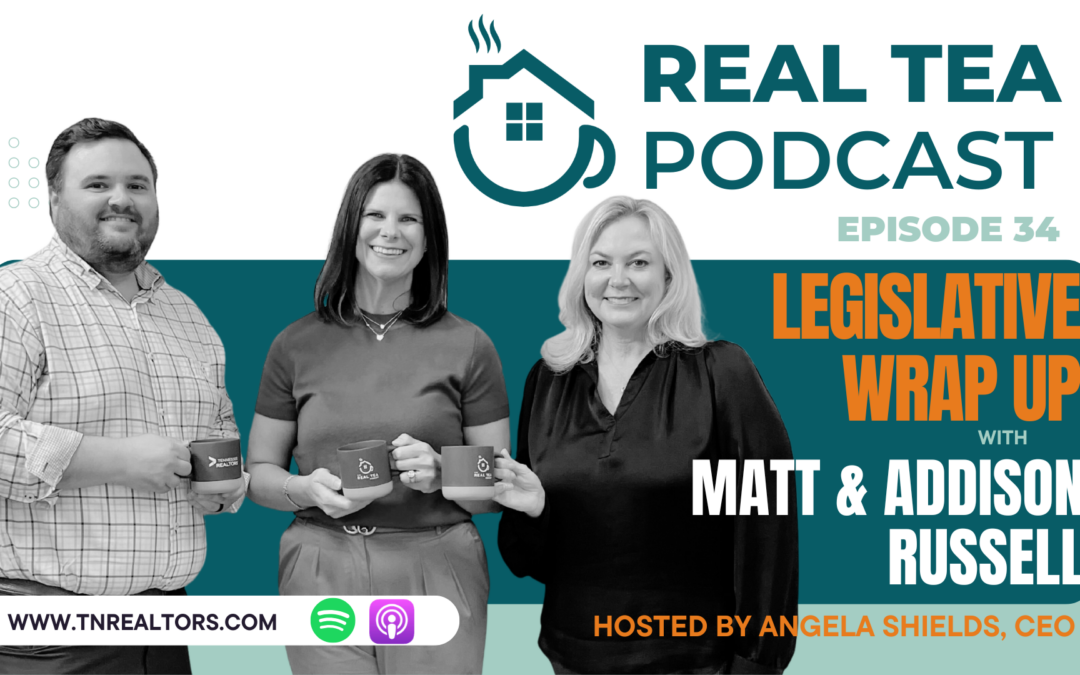
Our Tennessee REALTORS® Lobbyist, Addison Russell, and Lobbyist, Matt Russell, join Angela Shields in the RealTea studio for a comprehensive overview of our 2026 Legislative Season. They discussed some big wins on Capitol Hill this year, broke down law changes you’ll see impacting the real estate industry, and showcased how our Tennessee REALTORS® Advocacy is working for you.


Transcript
-
Welcome to the Realty Podcast, brought to you by Tennessee Realtors. I’m your host, Angela Shields. This podcast is created for Tennessee Realtors to get the T on all things real estate in Tennessee. We’ll bring you engaging conversations with esteemed guest in the real estate industry and cover a wide array of topics including current events, governmental affairs, education, and legal updates.
-
00:00:31:19 – 00:00:47:12
-
Angela
-
Welcome back to the Realty Podcast. We are extremely excited today because we’ve accomplished something major. We have got Matt and Addison Russell here together, and that is something we’ve been trying to do for a while.
-
00:00:47:12 – 00:01:01:18
-
Addison
-
It’s funny that you’re thinking that’s the major accomplishment because, like, we’re always together, not here, but I guess not here. The last time session had started and so he couldn’t come because he was was on the hill. Now we have a little, little time.
-
00:01:01:18 – 00:01:24:08
-
Angela
-
We’ve had you here separately and you both do a great job. You compete on who gets the best show. But today we’re going to make it an excellent show because we have you together for the audience to maybe has not tuned in. I want to make sure everybody is aware of who you are. So, Addison, I’ll start with you.
-
00:01:24:09 – 00:01:38:22
-
Angela
-
Addison Russell is our not only our attorney, but our lobbyist. You you both come from the same firm that is now rebranded to RF hours. Do I have that right?
-
00:01:38:23 – 00:01:39:18
-
Addison
-
Yeah. That’s right.
-
00:01:39:25 – 00:01:53:15
-
Angela
-
Okay. I want to make sure I do, but. And then Matt. Of course, Matt Russell is also a lobbyist with government relations with the same firm. And both of you do a fantastic job for us. So we thank you for that. And thank you for being here.
-
00:01:53:18 – 00:01:54:25
-
Addison
-
Thank you.
-
00:01:54:27 – 00:02:17:24
-
Angela
-
So I’ve asked you all the questions before about the tea. So we’re going to skip right over that and just jump into it because we’ve got a lot to talk about. The legislature has wrapped for the year and we have made some major accomplishments this year. So let’s just talk about when you look across the year, what are some of those accomplishments?
-
00:02:17:24 – 00:02:20:23
-
Angela
-
What have we done.
-
00:02:20:25 – 00:02:24:26
-
Angela
-
And then we went silent.
-
00:02:24:29 – 00:02:57:24
-
Addison
-
We didn’t do anything. We did so much. I think if you look at kind of realtor specific issues, and I know that for those that have been watching, we’ve been talking about them a lot. But one of the big bills we did this year as an organization was related to the vacation lodging Service licenses. In saying that if you have an affiliate broker or principal broker license, you don’t have to get this additional licensure to manage vacation lodging services, which is rentals for 14 days or less.
-
00:02:57:28 – 00:03:24:23
-
Addison
-
And what that process looked like was an eight hour class. And it was specifically to just that one niche. Whereas, you know, with their real estate license, you can do commercial real estate, residential real estate, property management. But if you wanted to do this short term rental management, you had to have an additional licensure. So folding that in under the bigger license, but while keeping that smaller license intact for people that are only doing those activities, that’s still an option.
-
00:03:24:26 – 00:03:32:14
-
Addison
-
So that was something that we worked hard on this year to get done. And I think that our members will see kind of an immediate impact from that.
-
00:03:32:15 – 00:03:43:14
-
Angela
-
Especially those that are in markets like here in Nashville and Great Smoky and even Knoxville. Some of those places where you see a lot of that short term rental.
-
00:03:43:14 – 00:04:08:14
-
Addison
-
And I think that, you know, you mentioned Great Smoky and really that was where that licensure came from in the first place. You know, the Smoky Mountains was doing short term rentals before short term rentals were cool. But with the take off of a lot of platforms, it’s kind of it’s really grown into a statewide industry. And so making it easier for real estate professionals to get into that space, I think will be helpful.
-
00:04:08:15 – 00:04:13:03
-
Addison
-
But while maintaining consumer protection, you know, that’s.
-
00:04:13:05 – 00:04:33:10
-
Matt
-
I think another few obviously bills that we passed, but more importantly probably bills that we worked against. I think we constantly talk about it, but there were multiple impact fee bills up this year, multiple landlord registry. So, you know, I think people often want to talk about the bills that, you know, what are we working on? What are we pushing.
-
00:04:33:10 – 00:04:40:27
-
Matt
-
But oftentimes playing that defense for the industry is probably, you know, the vast majority of what’s what what we’re accomplishing.
-
00:04:40:29 – 00:05:01:14
-
Angela
-
So many times I think about if you aren’t there, we would have those impact fees, we would have those registries. And I think that’s something their members don’t even think about because they’re out selling real estate all the time. Who would be there if you weren’t there to have those conversations, to talk about why those are not good ideas, right?
-
00:05:01:17 – 00:05:25:22
-
Addison
-
I think that’s really what lobbying and advocacy is. And it’s something that you learn by being a part of that situation, is things sound like a good idea and then you, you need a voice to say, hey, here are the negative effects of this. Like a landlord registry to a lot of people. Sounds like a good idea. Like, okay, we need to have someone to call that makes sense.
-
00:05:25:25 – 00:05:48:08
-
Addison
-
But what it like the impact of requiring that at a local level, especially if it comes with like a registration fee, it’s just a mandate on these landlords and your d incentivizing investment into our state. And that’s something that we want to be aware of. And so just, you know, trying to to spread the other side of that.
-
00:05:48:09 – 00:05:52:09
-
Addison
-
And that’s one example of how that works.
-
00:05:52:12 – 00:05:55:15
-
Angela
-
So.
-
00:05:55:18 – 00:06:12:14
-
Angela
-
When you when you think about some of the other things that we’ve worked on, I know there’s a lot of other things. Those are those are the issues that we deal with every year with the impact fees and the registries. But what are some of the other accomplishments that we had? I know that we talked a lot about affordable housing.
-
00:06:12:15 – 00:06:36:12
-
Addison
-
Yeah. And I was going to say on the heels of government fees and why we oppose this, and that’s to keep the cost of housing affordable. So some big things that we saw this year at the legislature. Governor Lee had proposed $30 million to go to THG. And and his his initial vision was to create a starter home revolving loan fund, which we have talked about, and we were very supportive of that.
-
00:06:36:14 – 00:06:55:00
-
Addison
-
But the $30 million stayed in and it’s going to THG, and that’s a huge amount of money, especially in the budget year that that we just been in. And the budget is like we’ve been in the past few years. But instead of the starter home revolving loan fund, they’re actually putting that to a workforce housing grant program. And I think that that will be really good.
-
00:06:55:00 – 00:07:16:09
-
Addison
-
I’m really interested to see what comes out of that. It’s it’s specifically for workforce housing. And it lists like essential professions and occupations. It’s not limited to those listed, but it’s like we’re trying to build a housing that police officers want to live in. Teachers want to live in. And it’s going to hopefully incentivize local governments to develop those.
-
00:07:16:10 – 00:07:38:01
-
Addison
-
Then also providing these grants to these loan programs administered through THC. In one requirement of the bill was that a project had to be in each grant of vision. So I think that that’s something that we were very excited to see a the money go there and stay in the budget and then to go to programs to try and create new and affordable attainable housing that.
-
00:07:38:04 – 00:08:00:28
-
Matt
-
Yes. And housing. We saw a low income housing tax credit. Additionally, where I guess previously those tax credits were taxed by local assessors as a property tax. So there was a bill this year that took that, or it allowed the locals to not tax that as property tax. A lot of people kind of gets down in the weeds of, well, why does that matter?
-
00:08:00:29 – 00:08:25:25
-
Matt
-
Right. Same thing that we talk about with landlord registries or impact fees. Any time that government is putting any new fees or higher taxes on the cost of housing, it makes it more expensive for the end user. I think a lot of people say, well, these developers are making a lot of money, but I think we need to look at ways that we can incentivize developers to come in and do these projects.
-
00:08:25:29 – 00:08:49:06
-
Matt
-
The numbers on low income housing projects are already very tight. So when we’re taxing something like that as a property tax, it only makes them even tighter and probably disincentivize the developers from coming into those communities. Right. So hopefully now with that bill that has been passed, we’ll see local communities that will take advantage of that and will encourage these developers to come into their, their local.
-
00:08:49:08 – 00:08:49:21
-
Angela
-
Right.
-
00:08:49:22 – 00:08:50:16
-
Matt
-
Local communities.
-
00:08:50:17 – 00:09:14:13
-
Angela
-
And we desperately need more developers in our communities because we we don’t have enough housing, all especially for, like you said, the essential workers to be in our communities. So it’s so important. So let’s talk about the Regulatory Freedom Act. Can you tell me about that?
-
00:09:14:15 – 00:09:17:04
-
I can tell you that one is another one that. Gets really.
-
00:09:17:04 – 00:09:36:04
-
Matt
-
In the weeds. Right? But a lot of people, when they think about government or they think about advocacy, they think about legislative session and Capitol Hill. But a lot of things get done kind of behind the scenes through rulemaking hearings, through, you know, through the departments that oversee a lot of, you know, our licensees.
-
00:09:36:06 – 00:09:36:28
-
So at the end of the.
-
00:09:36:28 – 00:10:04:04
-
Matt
-
Day, what the Regulatory Freedom Act is trying to accomplish is when these departments have these rules and these rulemaking hearings that they are now, I think it has to cost more than $1 million or an estimated cost of more than $1 million, that the department has to reach out to the pertinent associations or individuals that could be impacted, and they have to solicit now their information or their input on these rules.
-
00:10:04:05 – 00:10:29:11
-
Matt
-
Obviously, if you were involved in the process, when those those rule making hearings are happening, you’re able to kind of do that now. But this really just kind of puts the burden now on the departments, rather than interested citizen groups or whoever may be having to know that these rulemaking hearings are coming down. Now, the burden has shifted to the departments that are proposing the rules to reach out and say, hey, here’s a rule we’re proposing.
-
00:10:29:17 – 00:10:50:06
-
Matt
-
It’s clearly could have a huge fiscal impact on your association or your, you know, affected industry. Give us your impact or give us your your input. And I think, you know, we’ve seen that at a federal level. They’ve attempted I think it was called the Reins Act. They’ve tried that at the federal level. Tennessee is as one of a few states that have now implemented at the state level.
-
00:10:50:06 – 00:11:15:22
-
Matt
-
But I do think while a lot of people may not see a immediate or direct impact on that, it really is a piece of legislation that long term and really behind the scenes, could have a huge impact on how a lot of people do business or really just maybe even outside of their professional lives and just other things that impact their lives of of industries that that may have more input on regulatory issues moving forward.
-
00:11:15:24 – 00:11:39:12
-
Addison
-
And I think for our members, you know, the real estate commission, most of their rules and we follow those really well, don’t have a significant financial impact like that. But if you look at the Department of Environment and Conservation, which is a lot of where you’re building development is happening, and those really do have the potential to come at great cost to a consumer.
-
00:11:39:15 – 00:12:00:14
-
Addison
-
So it puts in, you know, more protections of like if it’s going to have this economic impact, it’s going to go through the fiscal review that the legislature controls. And like let’s let’s really nail down on this. And there are more safeguards in that in that regard. So I think that that will be I think that’s good for any regulated profession in the state.
-
00:12:00:15 – 00:12:13:17
-
Angela
-
Well, in more information and transparency. Yeah, that also helps a lot. And then I understand we have the community workforce Housing Innovation pilot program. What can you tell me.
-
00:12:13:22 – 00:12:19:00
-
Addison
-
And that’s a little bit of what I talked about. That money that’s going to that will be administered through THG. And that was an initiative of
-
00:12:19:00 – 00:12:27:26
-
Addison
-
Speaker Sexton. So I think that that will be good for the for the workhouse and trying to to get more products on the market through that program.
-
00:12:27:29 – 00:12:53:16
-
Matt
-
You know, just adding on that, I mean, we’ve heard obviously within our industry, right, a lot of about affordable housing, but I think now it’s it’s awesome to see that the legislature is really taking solid steps to allocate money and to put framework in and how a plan like this could work. So it really, I think, should give a lot of people hope that, you know, if this pilot can be successful, can we work to to see that expanded.
-
00:12:53:18 – 00:13:20:01
-
Matt
-
But I think it’s it’s really good news that the legislature now is is saying, hey, we acknowledge that affordable housing is an issue. Let’s see how we can get government involved without having too much government in the problem. I think trying to find a way that that government can assist but not do right. I think I think it’s very positive that we’re seeing the legislature starting to.
-
00:13:20:02 – 00:13:25:06
-
Angela
-
Do you think we’ll see a particular area they’ll start with, or is it is still new to tell anything?
-
00:13:25:07 – 00:13:46:04
-
Addison
-
I think that the conversation has been happening in very recent years, and I think that that’s encouraging where you’re hearing it as a buzzword, people are campaigning on it and and it’s not and it’s not just a buzzword and it’s not just a campaign thing, but I mean, I think they’re really seeing the crisis that we have in Tennessee, especially being a place where people are moving to daily.
-
00:13:46:06 – 00:13:50:14
-
Addison
-
We’re getting new residents. Companies coming, new companies.
-
00:13:50:14 – 00:13:52:20
-
Angela
-
Need those houses.
-
00:13:52:23 – 00:14:03:21
-
Addison
-
Which is great. And so I’ve been encouraged just by the uptick that it’s been in conversation across the aisle. Very bipartisan issue.
-
00:14:03:23 – 00:14:07:26
-
Angela
-
Why wouldn’t it be? I mean, housing is such a nonpartisan issue.
-
00:14:07:28 – 00:14:42:28
-
Addison
-
Everyone needs a house that’s like on your hierarchy of needs. Shelter is very important. And so we’ve seen it, the legislature the past few years. We saw it from the Lee administration. And so I, I think that that’s just really positive. And where we’ve kind of gone in the past years at the state level is incentivized trying to incentivize local governments to like to do programs that that will encourage development and not, as Matt said, put too much government in development, because usually that just really has the opposite effect.
-
00:14:42:29 – 00:15:06:16
-
Addison
-
But I, I think looking at what we can do to incentivize it. And then the legislature has just been really receptive to our arguments about how these do increase the cost of housing. And it hurts any affordable housing mechanisms. So they’ve been very receptive to those arguments. And that’s why we’ve we’ve been successful. And, you know, being able to stop a lot of those things.
-
00:15:06:17 – 00:15:18:22
-
Addison
-
So I feel like the environment is just really good right now. And it’s just a real opportunity to kind of come with things that that can help the housing industry.
-
00:15:18:25 – 00:15:41:07
-
Angela
-
So we’ve had several members express interest in the selection of settlement agents and real property transaction. Can you elaborate on what this bill requires and prohibits in regard to sharing title insurance premiums, commissions and other?
-
00:15:41:10 – 00:16:02:28
-
Addison
-
Sure. And I think that’s quote unquote a messy issue. Just because of the way it started was not the way it ended. And the way, you know, the legislative website isn’t always the most consumer. It’s a great website. They do a really good job, but you have to know how to be like, oh, amended, adopted and then go find the amendment and see what the final version was.
-
00:16:03:01 – 00:16:24:07
-
Addison
-
So the way that Bill started, and is probably as many people kind of remember it because we were opposed at the time when it was filed, was it was basically going to outlaw split closings. And those are very common in Middle Tennessee, more so than other parts of the state. And you had title attorneys on both sides of the issue with with differing opinions.
-
00:16:24:10 – 00:16:56:29
-
Addison
-
But we kind of thought that we got involved in opposing it, just, you know, didn’t really see the problem that I was seeking to address. I think the way that it ended this year actually does a good job of addressing a problem or, you know, finding a solution. And the way the bill ended up was just that if you are doing a split closing in the title attorneys or the closing companies are splitting insurance premiums or commissions or any other fees that the buyer and seller are paying.
-
00:16:57:01 – 00:17:22:14
-
Addison
-
They have to disclose that to the buyer and seller, and they have to get written acknowledgment that the buyer and seller, you know, it’s not just like a unilateral disclosure. The buyer and seller have to sign off on it. So it ended up being a bill that really promotes transparency to consumers and real estate closings. And I think that I know that the title industry works a lot on that, but I think that they got to a really good place.
-
00:17:22:14 – 00:17:34:05
-
Addison
-
So we ended up being neutral on the bill. And that’s that’s really just all it ended up doing was just requiring disclosure of that and promoting transparency in that regard.
-
00:17:34:07 – 00:17:58:01
-
Angela
-
And sometimes that comes from like you get to that point. It’s from where you are able to educate those lawmakers to. It goes back to what you were saying, that your decisions have an impact here. Or did you understand that when you wrote it this way, this is how it’s going to be practiced or what have you? And I love that about what you’re doing when you’re down there.
-
00:17:58:02 – 00:18:14:29
-
Addison
-
Yeah, exactly. And I think, you know, people here when, you know, they may have a constituent or another interest group and they’re like, this is, you know, we think this is wrong. And then you kind of have to say, look, but there are benefits to that. And then, you know, there’s no real harm or however you need to frame it.
-
00:18:14:29 – 00:18:29:13
-
Angela
-
But I think one time I remember you saying that a lot of times when they come, they come because somebody has come to them with a problem and they’re trying to solve the problem. But again, it’s they don’t think through how their solution is being applied.
-
00:18:29:17 – 00:18:32:14
-
Addison
-
Definitely. I mean, that happens. The regulator.
-
00:18:32:17 – 00:18:55:05
-
Matt
-
And I think that that Bill’s like a great example of like the legislative process. Right. Somebody probably came to a member from West or East Tennessee and, you know, maybe some title attorney came down from Middle Tennessee, where it’s common, and they were involved in transaction. It was different to that, that part of the state. And then, you know, they brought a bill and the folks was coming and said, hey, you know, we do this whole time.
-
00:18:55:05 – 00:19:16:07
-
Matt
-
It’s not that people deal. You know, let’s just disclose it. Right. So a bill that started off that kind of had everybody on opposite sides really ended up just saying, well, think about the consumer here and let’s just let them know. Right. Get Sumer has an issue with that. You know they can they can go elsewhere. So that’s a kind of a great example of the legislative process.
-
00:19:16:09 – 00:19:23:16
-
Angela
-
There’s some other things that were big that we did this year. So let’s talk about the big initiative we have coming up in November.
-
00:19:23:19 – 00:19:47:26
-
Matt
-
Yeah I think yes. On two is the state property tax prohibition. A lot of people know that I was in Tennessee. We don’t have a state property tax, but constitutionally they are allowed. So really at any given minute, as long as they’re in the in session, I guess a simple majority of the legislature, we could have a property tax by the end of that session.
-
00:19:47:29 – 00:20:12:20
-
Matt
-
So this has been a multi-year multi session effort by Tennessee, Rose Wars and a few other groups that helped push that constitutional amendment onto the ballot. So it’ll be on your ballot this November. And it is very important that folks get out and vote for it, because the way it’s calculated is based on the percentage of the governor, the good material votes.
-
00:20:12:20 – 00:20:42:02
-
Matt
-
So it’s very important that our members get out and our members are help educating folks about that, that amendment, because we do want to make sure that we stay a no no state property tax state. Obviously, I say state property tax because a lot of the misconception from some groups are that this would ban property tax completely, and this will change nothing for local governments that that want to impose their property tax for their local services.
-
00:20:42:04 – 00:20:51:03
-
Matt
-
But it is very important that we get out and we activate our members and everybody we know to vote yes on two in November.
-
00:20:51:06 – 00:21:11:11
-
Angela
-
This has been a very popular talking point for us. Whether it’s been we’re talking to other states or will, we’ve been at the Mipim conference and talking to those interested in looking at Tennessee. They’re very excited about that, very excited. So I think it’s very attractive.
-
00:21:11:13 – 00:21:12:19
-
It’s huge for sure.
-
00:21:12:21 – 00:21:30:02
-
Matt
-
I mean, obviously Tennessee’s attractive for a lot of a lot of reasons when it comes to to business friendly. You know, we ban the income tax. We’ve taken out the whole income tax. So really finishing it off with the state property tax could be a real big win for Tennessee.
-
00:21:30:03 – 00:21:31:10
-
Angela
-
Yes.
-
00:21:31:12 – 00:21:52:01
-
Addison
-
That’s a big factor that keeps the cost of housing low, especially as we talk about like aging populations. And they’re staying in their house and maybe their house is paid off. But then when you’re paying your property taxes that are that are going up, especially as, you know, the demand here grows, goes up. Not having an extra tax makes a big difference for a lot of people.
-
00:21:52:03 – 00:22:03:23
-
Angela
-
I agree 100%. Any other any other things that come to mind that that you’ve accomplished this year? The team has accomplished this year?
-
00:22:03:28 – 00:22:22:16
-
Addison
-
I think, you know, we talk about bills that pass and bills we stopped. But a lot of of what it is is also amending bills. We talked about the settlement agent bill that kind of got it became a totally different bill. But they were two other bills that come to mind that, you know, we put in we were able to work with the sponsors to get amendments on.
-
00:22:22:16 – 00:22:53:03
-
Addison
-
One of them was a bill by the more and Representative Parkinson and was actually about recording of eviction proceedings. And this is this just really emanates everything we talked about today, that there were people in Memphis that were being evicted, and the person doing carrying out the eviction was recording it. And then like putting it on TikTok and, you know, getting paid off of the views, but you’re just watching people, you know, lose their home.
-
00:22:53:05 – 00:23:16:12
-
Addison
-
And so they filed a bill that, hey, you can’t record it. But where we came in was and we’re like, obviously you shouldn’t put it on TikTok, but there may be legitimate reasons why you want to record it. And, you know, for the safety of the property manager, for the safety of the landlord, if you need to share it with your attorney, if you need to give it to law enforcement.
-
00:23:16:12 – 00:23:32:14
-
Addison
-
So we were able to work with the sponsors and get an amendment, along with the Apartment Association, who did a really good work on that to and, and put a list of people in the legislation that you can lawfully share these videos with. But it is not to the greater public.
-
00:23:32:16 – 00:23:33:10
-
Angela
-
Not for entertainment.
-
00:23:33:10 – 00:24:03:04
-
Addison
-
Right? It’s not for entertainment. It you know, it serves a legitimate purpose. And so I think but that was just an example of how like their these are real life situations. But they they go beyond kind of the, the headlines. Another bill was the Guns and Apartments bill. That’s kind of what I was referring to it as, but a bill that would allow tenants to keep firearms in their apartments, but also commercial buildings as well.
-
00:24:03:07 – 00:24:27:25
-
Addison
-
And what we did there was just able to say, hey, okay, but there can’t be civil liability on the landlord. So if someone was in an apartment building and the firearm discharged into their neighbors, you know that neighbor can’t sue the the property manager for allowing the firearm in the first place because it was state law. So we were put in civil liability protections.
-
00:24:27:26 – 00:24:39:03
-
Addison
-
And I think those are just examples of like when you see things happening, protecting the consumer, protecting our members and how we can get that done there.
-
00:24:39:06 – 00:24:51:12
-
Angela
-
And that is what you all do so well. You’re always looking at the consequences if the proper language doesn’t get placed in these bills, and we appreciate that so much.
-
00:24:51:15 – 00:25:19:02
-
Commercial
-
Register now for the annual Tennessee Realtors Fall Conference. Join us in Memphis, Tennessee, September 20th 1 to 20 fourth for industry insights. From engaging speakers, CE classes, networking events, and a whole lot of fun. Register before July 17th and take advantage of our early bird pricing. Don’t wait! Register now. Visit TNW Realtor.com.
-
00:25:19:04 – 00:25:29:06
-
Angela
-
So I brushed over it earlier, said that I thought you had looked at maybe a thousand bills, but off the top of your head, how many bills have you really looked at this year?
-
00:25:29:09 – 00:26:00:23
-
Addison
-
I mean, every bill that’s filed. So I think we’re over the past two sessions about 2700 ish. So that’s roughly 1500 a session. And yes, we get emails that have all the bills that have been filed that day. And and both kind of just do a deep dive into them looking at what titles they open up or like, what they’re relative to, and then reading them and flagging them for who, who may have an interest in them.
-
00:26:00:24 – 00:26:15:10
-
Addison
-
So a lot of what we end up tracking for the realtors are just kind of like, FYI, you know, this, this kind of touches property rights or, you know, this could at a later date. But right now it doesn’t do anything. And then what you really you nailed down into those really more substantive ones.
-
00:26:15:10 – 00:26:16:00
-
There are some bills.
-
00:26:16:00 – 00:26:41:01
-
Matt
-
Obviously just kind of talking and say, well, not interested us. But in Tennessee we have the single caption rule. So a bill can only do what the caption says. And so obviously if that captions so off the wall or unrelated to us, you can, you know, kind of probably not worry about as much. But, you know, for example, we could have something that said, you know, relative to animals, maybe we may not care about that.
-
00:26:41:01 – 00:26:56:16
-
Matt
-
Right. But it could then later say that, you know, landlords have to do x, Y, or z in relation to animals. And suddenly a bill that look so unrelated to us is suddenly super important to us. And so, yeah, just really knowing what those captions and.
-
00:26:56:18 – 00:27:03:01
-
Angela
-
I feel like we had that happen one time with cows and the slaughter bill and things like that. Oh my goodness, I do understand. I learned.
-
00:27:03:01 – 00:27:17:16
-
Addison
-
So much about slaughterhouses that year and it was so funny. I feel like there were other bills that year to. But we kept being in the Agriculture Committee and I was like, why am I in the Agriculture Committee like all session long? This is so scared. But yeah, I mean, it’s.
-
00:27:17:16 – 00:27:18:20
-
Angela
-
Just it’s you never know.
-
00:27:18:21 – 00:27:27:26
-
Addison
-
Never know. Like if you had just said if it had been like relative to the slaughtering of cows, but then it ended up being a property rights issue that we got involved in.
-
00:27:27:28 – 00:27:29:21
-
So and I think that was, that was a great.
-
00:27:29:21 – 00:27:51:05
-
Matt
-
Example of really how the state association can work with the local associations. Right? I remember that issue. It was something that probably statewide, we didn’t know about or didn’t really care about per se. But then when that bill changed, I think it was a local association said we just had a really big issue with this locally, and this is how it impacts us.
-
00:27:51:07 – 00:27:56:14
-
Matt
-
And so, yeah, that’s that’s a great example of a bill that we may not care about this suddenly you do.
-
00:27:56:15 – 00:28:17:09
-
Angela
-
Right. And then the other thing that as we kind of are coming to the end of this, I think it’s important that members understand that it’s not you two that are deciding what bills we’re following or what, or maybe not what we’re following, but what we are really honing in on. There’s a committee of members all across the state that you’re bringing this information to.
-
00:28:17:11 – 00:28:45:03
-
Addison
-
Yeah, definitely. We are not that different from a real estate agent, honestly. Like, you know, we can be your eyes and ears and mouthpiece, but it’s the committee that, you know, takes the positions and tells us why it’s important or why it’s not important. And then we just articulate that and and communicate that as your agent essentially. But that’s you know, the committee is so important in that regard.
-
00:28:45:05 – 00:29:06:06
-
Addison
-
They make those decisions. And then also like this, you know, working with the staff here to get information from like what is in a have any resources on this or other states doing stuff or communicating with the local Gads like you just said, that slaughterhouse bill was, was really important to one local association or like they had just seen it and they had the knowledge.
-
00:29:06:06 – 00:29:11:26
-
Addison
-
And so pulling everything to to put in front of the committee so they can make that decision.
-
00:29:11:29 – 00:29:26:10
-
Angela
-
And usually when one association sees it, it’s not long before another one will at some point. So I asked you about the bills, how many meetings do you think you have a year? And I know that’s going to be a tough question.
-
00:29:26:13 – 00:29:27:21
-
Angela
-
And I’m talking about with the legislature.
-
00:29:27:22 – 00:29:47:11
-
Addison
-
The legislators. So we schedule meetings on 15 minute increments, if not smaller and just all day. You’re going from meeting the meeting, debating, debating. So I say the average day or 20 meetings.
-
00:29:47:13 – 00:29:48:08
-
Yeah, probably.
-
00:29:48:09 – 00:29:51:05
-
Angela
-
A pace.
-
00:29:51:07 – 00:30:19:04
-
Matt
-
There could be. Yeah I know often throughout session it’s really we just throw the the meetings on our calendar and it’s just divide and conquer. Yeah. And figure out via text message who is going to get to that next meeting. You know, when we started at the legislature as staffers, the legislative calendar was a little different. They both chambers went in at 5:00 on Monday.
-
00:30:19:06 – 00:30:43:21
-
Matt
-
There was nothing on Monday afternoon, you know, our boss would come in probably around lunchtime. They went into caucus meetings and they went in. But over the years, it really has adapted to now, you know, 10 a.m. on Mondays. Committee meetings are starting. You’re meeting with legislators. So it really has has gotten to where it it is a lot busier down there.
-
00:30:43:21 – 00:30:57:17
-
Matt
-
And a lot of that is more they’ve become more efficient in the sense that they want to get out. You know, the other day their assistant legislature, they lose money to be down here. So they’re they’re ready to get back to their districts and see the people back home for sure.
-
00:30:57:19 – 00:31:12:14
-
Addison
-
I think those meetings can definitely give you whiplash. Like especially for, you know, we have a legislative intern every session. And so I like when they come to meetings with us. I mean, we could talk 3 or 4 issues on a variety of clients in like one 15 minute span. And I think it’s sometimes they’re like, wait, what?
-
00:31:12:15 – 00:31:29:12
-
Addison
-
What are we talking about? Like there there’s not a lot of deep dive that that’s why I think they’re building relationships outside of session is so important, not only for us, but also for the groups we represent. And to be able to say, hey, I’m here on behalf of the realtors, you know, like, oh, yes, I know my realtors.
-
00:31:29:12 – 00:31:38:03
-
Addison
-
And so it’s, you know, there’s like automatically this level of trust put into what I’m about to say on behalf of you. And then we can kind of like.
-
00:31:38:05 – 00:32:03:29
-
Angela
-
Yeah, and we won’t talk about it today, but then we can go into a whole nother conversation about how to use the PC program and all of that. But the last thing I do want to end with is we really try hard to stay in our lane when it comes to the the topics that we have you talking about, we don’t venture off into things that we’re not experts in.
-
00:32:03:29 – 00:32:13:17
-
Angela
-
And I would ask you both, how important is it that we do that, that we have you only talking about private property rights and about real estate issues representing our organization.
-
00:32:13:21 – 00:32:37:06
-
Addison
-
It’s so important. And so, you know, that statement I just made about the they know their realtors and they trust them because they know that, you know, the industry. And that’s what you do. And you’re you’re that voice. And so if we talk about our houses and if we had gone in there and say we oppose the slaughtering of animals, but why like.
-
00:32:37:07 – 00:32:39:14
-
Angela
-
You know, what does that have to do with say.
-
00:32:39:16 – 00:33:04:28
-
Addison
-
But why? And we only talked in that issue about the property rights stuff that was involved, because that’s what we do as a group. And that’s why gains you respect as a group. If you if you become too broad and take on other issues, you’re weakening your voice for the consumer and and for the industry. And so I think that it’s really important.
-
00:33:04:29 – 00:33:25:02
-
Matt
-
Yeah. I think as and I’ll both start off every meeting we have with legislators saying I’m here on behalf of. And I think by letting the legislator. No. Okay. I’m I’m here on behalf of the Tennessee Realtors, they can instantly know. Okay, well, I know who the realtors are. I know what they stand for. So I kind of know where this conversation is going to be focused on.
-
00:33:25:02 – 00:34:04:13
-
Matt
-
Right. And so then it’s important for us to to stay on those messages, because at the end of the day, you know, this and us as lobbyists for the association, we’re the voice of the real estate industry. And so it’s important that our voice stays where our voice knows, knows the subject. You know, I think, like you said, if we start venturing onto topics that aren’t real estate, it really does kind of draw into question when we start talking about actual real estate issues, because they kind of, you know, the motives of that messaging will begin to get questioned.
-
00:34:04:15 – 00:34:25:17
-
Matt
-
So it’s always important for us. Like I said, we started every meeting off who were there on behalf of. And that’s just a real or legislators know us obviously amongst different clients, but we want them to know which client were their on. And it’s good because they know that client name and they have a sense of, okay, I know what we’re going to talk about today.
-
00:34:25:20 – 00:34:49:21
-
Addison
-
And I’ll say, you know, not only saying who are there on and then saying our position, but but the why. So if we go in and we talk about where against impact fees, the why, isn’t it because we don’t like taxes. The why is because it has a negative effect on the cost of housing. You know, if they’re proposing a tax on electric vehicles, that doesn’t have anything to do with with what we do.
-
00:34:49:21 – 00:34:58:01
-
Addison
-
And so, you know, we’re not just like an in anti-tax ink tank. You know, we’re an anti tax on housing.
-
00:34:58:01 – 00:35:28:17
-
Angela
-
And have the data to show how it will impact. Right. Right. Well obviously the work that has been done with you with the governmental Affairs committee, with the committee, it has the backing to show the differences making in our state when it comes to private property rights, housing, the real estate industry. And I say, keep up the good work because it has been phenomenal, the headway we’ve been able to make.
-
00:35:28:18 – 00:35:48:18
-
Angela
-
You know, you’re never going to win them all. But I think that we are very fortunate to live in Tennessee and under the conditions that we are in, we are doing really good work. So thank you, thank you, thank you for all that. I think there’s so much more we could talk about, but we would be here for several hours I think.
-
00:35:48:18 – 00:36:03:28
-
Angela
-
So we will definitely have you guys come back and finish the conversation and talk about those ten pics, talk about our pack law and talk about other, other things we see for the future, because it’s probably going to be an exciting year next year too.
-
00:36:03:29 – 00:36:09:28
-
Addison
-
Definitely. I mean, I think that, you know, we’re heading into elections. Not much is always interesting.
-
00:36:10:04 – 00:36:11:00
-
Angela
-
To talk about.
-
00:36:11:00 – 00:36:21:11
-
Addison
-
A lot to talk about. And, you know, some some leadership changes at the state level. So I think that kind of heading into a new day next year.
-
00:36:21:13 – 00:36:30:09
-
Angela
-
We’ll definitely have you guys back and kind of get that recap. All right. Thank you. Thanks.
-
00:36:30:12 – 00:36:47:26
-
Angela
-
Thank you all for joining us today on the Realty Podcast. If you enjoyed this episode, please share it with your friends and colleagues. Then visit Realtor.com to submit your questions and topics for future episodes of the Realty Podcast. Thanks for listening.