
Fraud and scams are ever-changing and more sophisticated than ever. Ryan Byrne, Attorney at Law with Byrne Westmoreland, PLLC in Memphis, sits down with Tennessee REALTORS® CEO Angela Shields in the latest Real Tea Podcast episode to discuss the many types of scams and frauds REALTORS® should be aware of. His practice includes real estate closings; wills, trusts, and estates; and titles and title insurance.

As an attorney licensed in both Tennessee and Mississippi, Byrne has encountered numerous types of scams and frauds in his career. According to Byrne, seller impersonation fraud is the #1 fraud happening across the U.S. With seller impersonation fraud, the fraudster poses as a property owner and hires a REALTOR® to list and sell the supposed property. “…Unfortunately, in these situations, the REALTOR® becomes an unwitting accomplice to this crime,” he said. This type of fraud requires a lot of preparation, from creating fake email addresses and fake IDs to using bogus Social Security numbers. Fraudsters fabricate a story about why they’re not local and make excuses for why they don’t live in the area or can’t attend a closing; they try to reassure victims by claiming they have a notary. They convince the victim they only want to use certain, limited methods of communication, like email and text (e.g., too busy, lives multiple time zones away, etc.). They’re motivated to find a REALTOR® who will, in turn, find a cash buyer and do a quick sale for less than market value.
Byrne notes that these instances, if taken separately, don’t seem too concerning, but when they’re all added together, it should raise a red flag to the REALTOR®. He says that because of these scams, REALTORS® now have to be diligent with verifying the identities of all parties in a transaction.

Counties throughout Tennessee are implementing their own online anti-fraud registries one by one. If a county has an existing anti-fraud registry, homeowners can register by inputting their email through their county registrar’s office website. Once registered, they will receive email notifications every time their property is recorded. Unfortunately, this service isn’t available in all counties yet. The more populous the county, the more likely it is to have an anti-fraud registry.

Title companies are starting to recognize that seller impersonation fraud is becoming a bigger problem. Because of this, many are now offering enhanced title insurance policies. These enhanced policies include 19 additional coverages compared to standard policies, including post-closing forgeries and fraud. Byrne recommends REALTORS® to take a close look at how prospective clients find them. If the person is outside of the REALTOR®’s “sphere of influence,” or not connected to the REALTOR® in any way, he said that should be a red flag. “I think for brokers and from a risk perspective of all of our licensees in the state, attending training, talking about these things… When you get pushed back from clients and explain why you’re having to obtain this information or why it has to be done a certain way, if you’re not a scammer, most people are going to understand and actually appreciate the extra steps that you’re taking to protect their money and their investment.”

Byrne reminds REALTORS® that protecting their client information is now a part of their job description. He said that in the past, it was easy for a REALTOR® to deflect clients’ issues and ask the client to seek resolution through the other parties in the transaction, like a loan officer or closing attorney. With the establishment of the Consumer Financial Protection Bureau (CFPB), it’s no longer the case. “We have a collective responsibility, all of us in the transaction, to protect clients’ private information. So, offices need to have a policy and need to be talking about this stuff every day in their offices.”
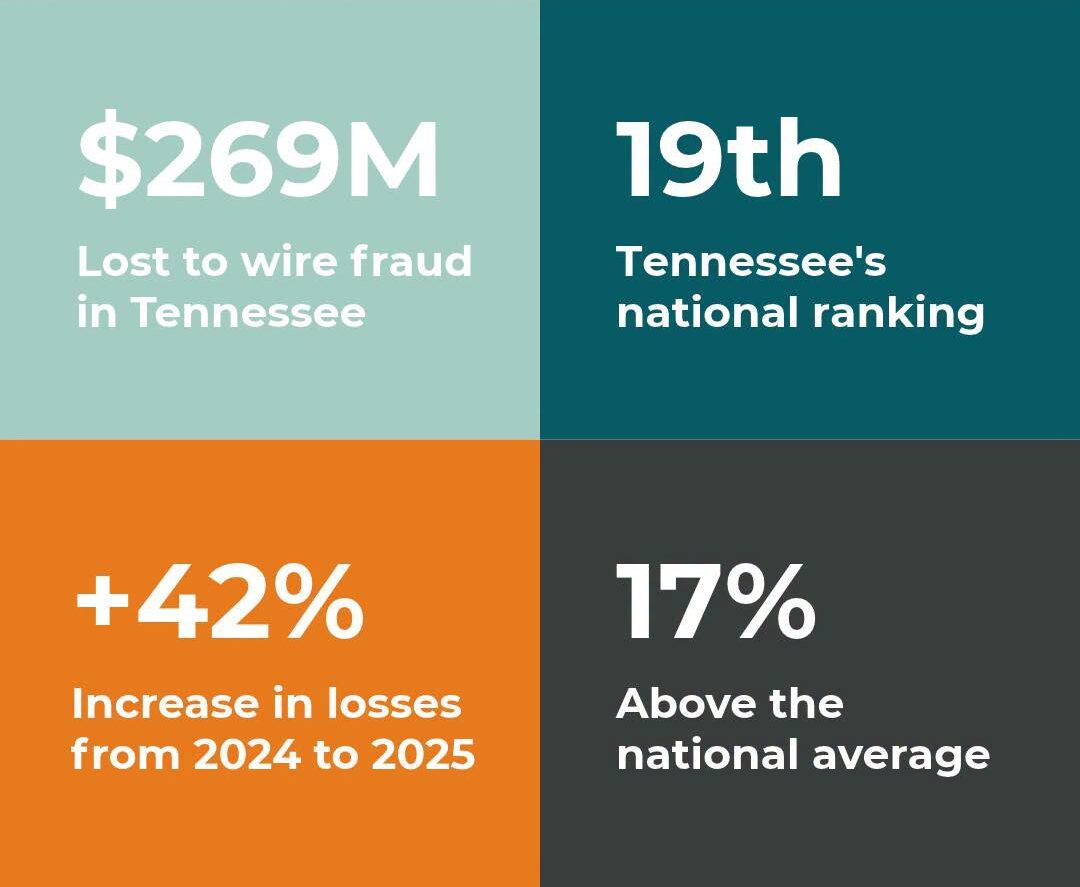
Wire fraud is still a scam that hasn’t gone away. According to Byrne, fraudulent schemes cost over $269 million in Tennessee alone in 2025, placing the state at #19 in the nation. That amount is a stark 41.5% increase from 2024 (roughly $190 million), and the state is 17% above the national average. “So, if you think that in small-town Tennessee–you’re a REALTOR® and your closing office is not going to be susceptible to this, you’re just wrong,” Byrne stated.
So, what happens if a REALTOR® and their client become a victim of a scam? The first thing they need to do is call their bank and ask it to send a message to the recipient bank through the SWIFT Federal Reserve system (bank-to-bank communication) that it was a scam and to freeze the account. Victims should then file a complaint with the Federal Bureau of Investigation’s Internet Crime Complaint Center (IC3) and local authorities. A police report may be needed for insurance purposes if there is any insurance coverage for the incident.
 

Tennessee has a wire fraud warning form which Byrne believes is the best in the nation. The form explains the danger and leads to the critical step of starting a conversation between a REALTOR® and the consumer. “From here on out for the rest of your career, I want you to tell every consumer verbally to them, ‘You will never receive wiring instructions from me.’,” Byrne emphasized. Once the consumer learns this critical information, it will trigger in their minds if they receive fraudulent communication asking them to change the wiring instructions. He warns that REALTORS® shouldn’t be involved in the money-wiring process. “Your E&O insurance will not cover you for that, and if any REALTOR® is providing wiring instructions for the closing office to their client, stop.” It causes unwanted liability, and the E&O insurance specifically excludes it because it isn’t considered real estate-related activity.


Many REALTORS® conduct business from their personal email, such as a basic Gmail or Yahoo account, instead of a company email with built-in protections. Personal email accounts are easy to hack, and in wire fraud cases, the REALTOR® email is often the weakest link. An example: In the case of Bain vs. Platinum Realty, a REALTOR® was hacked. The wiring instructions were changed, and the buyer wired money to a fraudster. The buyer then sued everyone in the transaction–the brokerage, the REALTOR®, the closing office–and the REALTOR® was found to be 85% liable on roughly $200,000 worth of damages. This case reminds us that REALTORS® should not handle or be involved in the money-wiring process.

With the CFPB regulations, closing offices and lenders are required to send emails via an encrypted channel, whereas REALTORS® do not have that regulation; their personal emails do not have the same protection or encryption features. When closing offices send encrypted wiring instructions to a client, they purposely leave off the last four numbers of their escrow account as an added layer of protection. The client would be required to call the closing office to give the last four digits.


If a REALTOR® is still making copies of earnest money checks and emailing others (other agents, lender, closing office) unencrypted, scammers then have enough information needed to sell a client’s identity on the dark web. These checks contain a name, address, phone number, routing number, and account number. Byrne strongly suggests REALTORS® either stop the practice or redact the routing and account numbers with a Sharpie marker. He also has observed an over-reliance on texting. “…Due to the statute of frauds, everything we do in our practice has to be in writing, and there are no shortcuts,” he said. “And I see REALTORS® trying to negotiate an entire deal via text message before anyone writes up the contract because they want to save time. That’s not how you practice real estate properly. Unfortunately, we need a paper trail if the deal goes south and one party wants to sue for breach of contract. A series of text messages isn’t enough. It’s not going to be considered a writing.”


There are ways a REALTOR® can stay informed and reduce their liability risk. Byrne believes more training is needed and strongly recommends that members take a real estate title fraud and wire fraud class to learn ways to protect themselves. There should also be policies in effect in case a client is scammed. Lawsuits look at what the REALTOR® did and what they did or didn’t do. “If you’ve got a procedure in place and you’ve advised your clients and you stayed in your lane, there’s not going to be liability there,” Byrne said. “Talk about it, have training, continue to take classes like this. It’s vitally important. These scammers are staying one step ahead, and we’ve got to be vigilant in our practice.”