Real Tea Podcast – Season 2: Episode 14
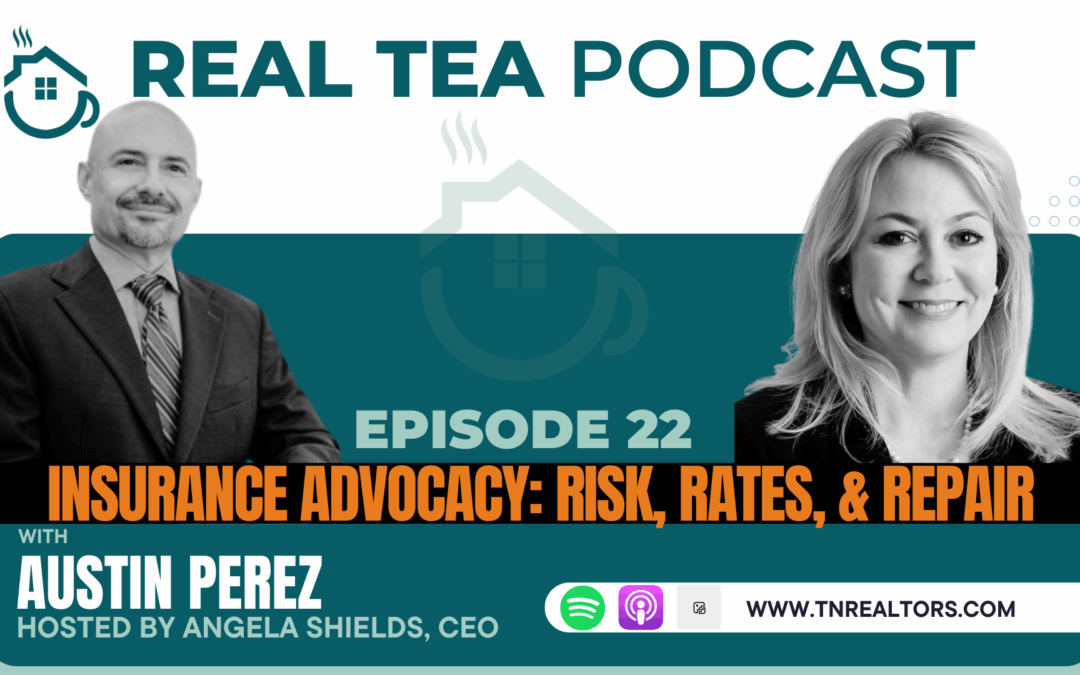
Insurance Advocacy: Risk, Rates, & Repair
We sit down with NAR’s Senior Policy Representative for Insurance Issues, Austin Perez, to discuss the advocacy work NAR is doing on our behalf in Washington. We talk about advocacy efforts, the relationship between risk, rates, and repair as it pertains to insurance, plus we dive into the best way you can be a value to your client.
Learn more: https://www.nar.realtor/natural-disaster-policy



Read
Welcome to the Real Tea Podcast brought to you by Tennessee REALTORS® and sponsored by Rural 1st, “helping you live closer to what matters.” I’m your host, Angela Shields. This podcast is created for Tennessee realtors to get the “tea” on all things real estate in Tennessee. We’ll bring you engaging conversations with esteemed guests in the real estate industry, and cover a wide array of topics, including current events, governmental affairs, education, and legal updates.
Angela Shields (AS): I am super excited today to have Austin Perez with us from the National Association of REALTORS®. Austin is the Senior Policy Representative for Insurance Issues. And this one is particularly special for me because I had the opportunity to see Austin in action at NAR. And we’ll talk about that a little bit later. But welcome, Austin.
Austin Perez (AP): Thank you for having me.
AS: Austin, before we get started, we have a tradition here on the Real Tea Podcast. And because we’re called the Real Tea, we ask everyone and look at you going to drink something there. We ask everyone, “What is in your teacup? What do you like in your teacup? Are you drinking tea right now?
AP: I am not drinking tea. I am drinking coffee. Normally, I’m just a straight black. No cream, no sugar. That’s that’s what I’m drinking right now.
AS: So, you you prefer coffee over tea?
AP: I do. I like–I love me a London fog every once in a while but no, for the most part, I’m more a coffee drinker. I tell you what, this this podcast has exposed me to more types of tea. It is unbelievable. It is crazy.
AS: So, it looks like you’re traveling. Tell me where you are.
AP: Yeah, so I’m at the California Association of REALTORS® GAD Institute. They have me here presenting on home insurance issues –trying to get a read in California, how to bring down cost, increase the availability of home insurance. Let’s be honest, insurance becoming a much more significant and confusing part of home ownership and our members are amazing. I’m sure our members–they’re asked, they’re usually the first go-to for a client to ask about a whole range of questions. But I–here’s the key that I’m going to be telling the California REALTORS®: You don’t have to be an expert. In fact, trying to be an expert can get you in a lot of trouble. Our members are are amazing resources at going the extra mile for their clients but they don’t need to know everything or be all things to all people. The best way that they can add value to a client is to be the source of the source. I hear that often. A connection point for trusted insurance and other professionals who can help answer their clients questions. So, I’m excited. I’m going to have be on a panel later today to talk about that. And so I’m here in my hotel room in Santa Barbara, California.
AS: Well, we very much appreciate you taking the time to join us today. I know there is a lot to talk about when it comes to homeowners insurance, disaster insurance and every other kind of insurance that’s out there having to touch our customers, clients and our members. So, let’s dive into that. Do you want to start with homeowners insurance since you are–you’ve got that top of mind obviously right now?
AP: Uh, yeah. Well, and I mean, again, I just I think this is one of those situations where a lot of clients are asking our members for information that’s outside their license and training but our members want to bend over backwards, provide excellent customer service and so, you know, they’re asked a question and rather than just saying, “Hey, let me, you know, I have a couple of insurance agents who can be really helpful that I’ve worked with in the past, let’s get you connected so they can answer your your questions. A member will say something like, “Oh, well, you know, it’s not required” or “Yeah, you–don’t worry, you’re–you know, like your home, you’re never going to flood. I’ve been in this neighborhood 20 years and I’ve never seen a flood” or “I’ve never seen a–you know, windstorm.”And you know, those are the kinds of things, those are the kinds of statements they’re outside the license and training. It can really get a member, especially an inexperienced member in trouble.
AS: Well, and in today’s society, it’s never say never because my goodness, things are happening everywhere.
AP: Absolutely. Absolutely.
AS: Yeah. And I will tell you, I had the opportunity–and it was a great opportunity to serve as the AE rep on the Insurance Committee several years back. And one of the things that I learned and I’m sure you can speak to is that when it comes to insurance where an agent can help, a member can help is talking to their customers and clients about the fact that if you bought a house so many years ago, many years ago, that you might need to talk to your insurance agent about the value of your home because your insurance may not cover if something were to happen and you had to replace that home, if it burned down or if a tornado took it out. There’s a lot out there today that’s talking about the fact that the value of your insurance you bought 20 years ago may not cover the replacement.
AP: Yeah and that’s a that’s a really key point. So I guess taking a step back–clients may not understand that insurance is based on replacement cost and not market value. You know, real estate professionals, they use comps in order to recommend listing prices but what insurers are using are construction costs to estimate what it costs to rebuild or replace a home to–with a similar property of like-kind in condition. So, you know, I once had a homeowner with a client with a REALTOR®. I was talking to him and the member and the client was complaining about how he had these beautiful wood custom windows and the insurance company after a tornado wouldn’t replace them; wanted to provide aluminum instead. So that’s what insurance companies what the insurance policy–which is basically a contract–that’s what it means by “like-kind” of condition which is a term that you’ll see in in the insurance contract is they will give you something of similar like and kind but it’s not exactly the same thing. So that’s just a reason why encouraging clients to talk with an insurance agent and frequently because they may not be writing the fine print and they may need the insurance agent to really sort of slow it down explain to them what does replacement cost value mean.
So that’s exactly the kind of example where you know regularly, you know maybe even annually, encouraging your client to talk with a licensed and experienced insurance agent–not just any insurance agent but one that the member has worked with over the years or at least a couple of names of people that they’ve worked with over the years to make sure that their clients can get answers to the information that they need.
AS: Yeah, I know. After hearing that, I immediately came home and had a re-evaluation on my property and made sure that I was covered and realized that I needed to increase my value of my insurance for that very reason. So, there’s a lot to learn.
AP: Well, and so I have a personal experience myself. Um, a couple of weeks ago I had a microburst and across the street–this–I don’t–we didn’t ever get a wind estimate–the wind speeds. It picked up a tree and pushed it into my neighbor’s house and then it fell on another tree which fell on my property. Thankfully, did no sort of damage. So, I started doing–looking at my–I checked my insurance annually and started looking around replacement cost values and realized I’m probably significantly uninsured. So, I went to my insurance company to up the coverage and they fought me on it. And I was like, I’m trying to give you money here. Why won’t you let me raise my coverage amount? And they explained that it’s–that it–you know, it has to do with they don’t want me to be overinsured and the information they had wasn’t consistent with mine. So I decide I’m going to go get my–I’m going to go shop around. I’m going to go find another insurance agent who is more likely to give me my replacement cost value and I found an insurance company that gave me–that’s willing to give me guaranteed replacement cost coverage. “Guaranteed replacement cost coverage” means that if my home is say $500,000 and a year from now it’s damaged destroyed and it costs a million dollar–and I’m pulling these numbers out of the air–a million dollars in order to replace my home to build it to like kind and condition then they will spend the million dollars. That’s what guaranteed replacement cost coverage is, which is very rare. I was very fortunate to find an insurance company who’s willing to give me that.
But it just it gives you an example where I had a concern. I didn’t I wasn’t happy with the way I was provide–I was treated by an insurance agent. So I shopped around and found an insurance policy that works for me. One last thing I’ll say about this: The insurance provider, in order to give me that guaranteed replacement cost coverage, pointed at a tree in my backyard and said, “I’m not so sure if that tree is sitting over your house, what–you know, like I’ll trust you if it’s not sitting over your house but you know, like if there’s a loss and that tree is sitting and it falls–” and so I cut down the tree. So, you know, like and that actually is in my best interest for the insurance company to tell me that because it gives me a piece of information from a cold hard risk analysis. That tree makes me not as good a risk and insurance companies can’t afford to take the bad risks. And so, they were giving me a piece of information and I acted on it. So, fingers crossed in a couple of weeks from now I’m going to have that guaranteed replacement cost coverage and I’m not going to have to worry. I’m going to sleep very soundly.
AS: Right. But again, it goes back to–I think all of the examples are how we educate our members to be the source of the source and not taking on that responsibility. So, I love that. So, we’re talking about acts of nature. So, let’s kind of go into that. I know you do a lot of work when it comes to flood insurance and disasters and that type of thing. So let’s–tell us–tell us a little bit about that.
AP: Sure. Well, so a couple of things. What is an insurance policies? Think of them like professional card players where they’re playing against the house which is–in their instance–mother nature. So the only way they so they have to place bets as card players. They have to place bets but if they place one bad bet and they lose all their money, they go insolvent. And so have they have to be really smart about their investments. And we’re talking about the weather. I don’t even know with confidence what the weather is going to be like tomorrow. Not exactly but they’re trying to predict over the next year what their weather is going to look like. So they are taking a bet. And the way they stay in business is they have to place a series of smart bet if the odds are in their favor.
So, why this is relevant is, you know, going back to the tree, if a if an insurer tells a client, “Look, we’re concerned about the roof or about this tree,” what they’re seeing is just based upon looking purely at a risk analysis–no emotion involved, no attachment to the home, purely based upon the risk to that house. They’re trying to gauge whether it’s a smart bet or not-so-smart bet. So if they say look if you remove that tree then we’re willing to ensure they’re basically saying that that’s the way that they make those smart bats and that information is useful because it tells a client about the cost of owning the home including the natural disasters. So, a lot of what I do, it’s flood, it’s natural disaster insurance, is basically just make sure one in flood insurance, there’s a National Disaster Flood Insurance program.
With home insurance, it’s regulated by the state and most things–other than floods and earthquakes–are covered by that home insurance policy. But it’s really about making sure that insurance companies based upon assessments are able to one, cover their expenses over time and two, make sure that clients one understand what’s being agreed to in that insurance policy the contract but also trying to find an insurance rate that is affordable and available. So it’s kind of like a venn diagram–I like to think of it a venn diagram. I don’t know how many people know where it’s like you have two circles and there’s an overlap between the circles. What I look for in flood and other disasters is one circle is what does it take for the insurance company to cover their costs. The other circle is what does it take for the client, the home buyer, to get an affordable insurance policy. I’m looking for the intersection between those two circles. And that’s really the the skill and the luck of trying to work on these issues at the national level.
AS: I remember from serving on that committee seeing some really neat products like 3D printing and things like that, that they are now using for homes. Can can you talk about some of the things that you’ve seen the trends that you’re seeing when it comes to–trying to–I don’t know, fight mother nature or work with mother nature if you will to still provide homes that can being the disaster zones or the zones where we know that mother nature is going to win.
AP: Yeah. Yeah. Absolutely. Mother nature always wins eventually.
AS: Always wins.
AP: Always wins. But–so yes, the most effective trend these days in insurance is strengthening your homes against natural disasters. Homes built or retrofitted to stronger building codes. They suffer less disaster damage which means that there are fewer claims to properties, meaning it’s lower risk and lower cost for an insurance company to insure that property. There was a recent piece of research. It’s the first of its kind study of one of these programs in Alabama. Alabama has this program, it’s called Smarter Alabama Homes–or I’m sorry–Strengthen Alabama Homes and basically what the program does is if you replace your roof and you put these little like $2 fasteners on the roof to hold the roof down in the event of a hurricane or a tornado or a windstorm, Alabama directs the insurance company to provide a discount from 20% to 50% depending on the amount of improvements you make to the property to withstand hurricane force wind.
So researchers recently looked at that fortified roof standard after Hurricane Sally in 2022 and it turns out that if everyone on the coast had upgraded to this fortified roof standard that Alabama offers, the average homeowner that was caught in that hurricane would have saved $1,300 out-of-pocket in deductible expenses. That’s an amazing number that the Alabama fortified roof is so effective that they proved that homeowners just in deductible expenses alone, forget about the insurance company would save $1,300. The the federal government can help support programs like this is one of the things that any is working on but these stronger, safer homes reduce the cost and make it easier for insurers to continue insuring homes. So that’s really the focus. How you–if you want a more affordable insurance policy, the way to do it is to strengthen your home against natural disasters and that’s what we’re working on at NAR.
AS: So, that sounds like something that maybe members could also help with is to educate their customers and clients about some of these products or programs that are out there to help them save money.
AP: Yeah, and you got to be–Yes. NAR provides information, handouts–we have any legal guidance, what to say, not to say to a client. You have to be careful. So in–and this is what I mean by that: in the flood insurance space–every real estate professional with a license, it’s probably been drained in–drumed into their brain: focus on the facts. So with flood insurance, what’s the most memorable fact if not the lender requires it or does not require it? So the member is telling a client, “Well, you know–,” they ask the question, “Do I have flood risk?” and the member says to him, “Well, the lender doesn’t require it.” What the member is saying is they’re giving a fact like they were licensed and trained to do. But what the client hear is, “Oh, the lender doesn’t require it, so there’s no risk.” and that is absolutely not true.
I mean, you and I, Angela, have talked about some of the floods that have hit Tennessee recently. The floods do not respect lines on a FEMA map and so being careful not to suggest that, just–you know, just get a sump pump, you know, and you’ll be alright, you know, like you don’t want to say a home is floodproof. You don’t want to say a home is is proofed against or suggest in any way that a home can withstand a natural disaster. What you want to do is you want to find an expert and we can help connect you with experts like the Institute of Business and Home Safety in South Carolina. All they do, they have a lab and all they do every day all day is blowdowns, wash away and burn down homes in this big laboratory like hanger looking laboratory. The insurance companies pay this scientific research outfit laboratory in order to give them the science they need in order to set their insurance rates and figure out where they’re going to insure or not. So, being able to get someone on the list that–IBHS is the acronym for Institute of Business and Home Safety–getting an IBHS certified expert on your team, having a short list of those experts in your areas and if you don’t know who they are, you can find them. But having that list of experts who say, “Hey, well, you know, if you strengthen your home against a natural disaster, insurance companies are likely to look at you more favorably when they decide whether to insure and what to charge you to ensure. But just to be safe, let’s get you connected with an expert who can give you a property specific assessment and tell you what kinds of things you could do to the home to make it safer and stronger.”
AS: I heard a weatherman here recently say if you live anywhere that it rains, you should be concerned about flooding.
AP: So, yes, I’ve heard that too. It’s a–I actually–my favorite way of expressing that. I have a colleague in Florida who pulls out a a wallet and says if your license says Florida, you need flood insurance. So, but some, you know, FEMA actually says that wherever it rains, it can flood. And if you don’t believe it, Asheville, NC, which is in the mountains literally 3,000 ft above elevation in the mountains–whole towns were wiped away. No one thought–everyone thought that, you know, it would take a Noah’s Arc level flood in order to flood these communities. It wasn’t even on FEMA’s maps as anywhere close to a flood risk. Those properties were destroyed in the mountains. It just goes to show like our friends at FEMA say, “Wherever it rains, it can flood.”
AS: Yes. Yes, it is unbelievable these days where things can happen. So all of these things that we’re talking about, would you say this is how your premiums are determined where you live, what could happen? Can you kind of explain how the premiums are set?
AP: Sure. So, I’m I’m going to simplify it. The insurance rates are basically just what you are expected to–it’s what your client is expected to incur in disaster repair costs over the next year. So, insurance premium equals repair costs to a home–likely repair cost to a home. It’s that simple. And a little bit more explanation on that: what an insurance company is doing is they are trying to figure out what they are likely to pay out in claims on the property over the next year. So they come up with something called a “loss cost.” That loss cost includes natural disaster risk. It’s based upon in many instances; it’s based upon very sophisticated computer modeling in addition to past data. These companies are going to global expert risk assessment companies and catastrophe modelers and what they’re doing is when they come up with a rate, about 65% of the rate is what are they expecting to pay out to repair that home over the next year and the rest is just expenses and a normal rate of return.
So, when you see an insurance rate that’s $1,000, roughly $650 of that is what the insurance company is expecting to pay in claims over the next year on that property from all disaster risk, floods–not floods for in homeowner space, but in homeowner space–fires, windstorms, tornadoes, anything that you get. So like that rate is a signal of disaster risk. That’s the most important thing and the truth is when–homes are sold and there’s a listing price put on it and that home is sold, it’s not accounting for the disaster costs. In other words, the disaster costs are a hidden expense to a home purchase. So, how do you make sure that when a client buys a home that they’re considering the full cost of owning that home over the next year? That’s where that insurance rate comes in because if the client knows that the insurance rate is and I’m pulling this number out of the air–$5,000 over the next year, the buyer can take that $5,000 premium to the seller and negotiate at the closing table over the adjustment to the listing price in order to reflect the natural disasters.
So, that’s why the insurance rate is so important and having it at a full risk level. I keep telling members you should think about full risk insurance costs as your best friend or you should make friends with their those full risk rates because at the end of the day if you help a buyer buy a home and in the next five years the rate goes up 20% per year or becomes uninsurable or it experiences five floods and again, I’m pulling this out of the air, and the the former client now the owner decides to sue as the most physical visible face in the transaction that exposes our our members to reputational and liability–risk and liability.
And so the key is is making sure that those buyers know what that–the full cost of insuring the home is actually helping our members to make sure that a buyer is making an informed decision and also to make sure that the client doesn’t come back and say, “Hey, you told you didn’t disclose to me that the rate was $5,000. You just told me to go to an insurance agent.” And frankly, it’s not realistic for them to expect the the real estate agent to know it’s $5,000. But our members get sued for everything. And so it’s really important to make sure that that client goes to a reputable insurer, knows what the full cost to ensure the home in addition to the sales price of that home before they put down an offer. They need to do it in advance. They need to have that information in advance so that the buyer can make an informed decision and not bring it back on our member later if it becomes uninsurable or suffers repeated damage to the property.
AS: Right. There’s–I know there’s a lot going on in the insurance space and so far, we’ve covered the disaster insurance, we’ve covered homeowners insurance. But I know that you focus on so much more. I’ve personally seen it. So I do want to make sure we have time to talk about other trends that you follow. So let’s let’s pivot just a little bit and open that up. So tell me about other things that you are personally following there at the Capitol for us.
AP: Uh sure. So we cover all insurance issues–we cover floods and homes and disaster which we meant–which we just mentioned. Terrorism risk insurance is going to be up for reauthorization in 2027. That’s already beginning so we’re we’re covering that. Health insurance. That’s a big one. And it’s what you alluded to earlier, Angela. So, for the audience if they don’t know: NAR was asked to testify before Congress on the ability for trade associations to be able to offer a health insurance plan for independent contractors and other small businesses of one or just very small businesses that have either one or up to 49 employees. Right now that insurance–if you’re an independent contractor, federal law requires you to go to the Affordable Care Act. The Affordable Care Act does not work for a large number of our members.
So, a couple of years ago, Tennessee offered an Association Health Plan authorized by the Department of Labor under the first Trump administration but I think it was like 19 blue state Attorneys General sued, went to federal court and won. Tennessee had to unwind that one of the best AHP programs in the country because there was a disagreement between blue states and red states and it ended up in court and the court sided with the blue states. So, Angela on NAR’s behalf testified before Congress that not only should small businesses of one have options like large businesses–like say in Tennessee, you have FedEx, you have Bridgestone–they’re offering excellent insurance plans to their employees. Why? Just because I’m a small business of one. I work for myself. I’m an independent contractor. Why should I be stuck in a high-cost market in the Affordable Care Act? Maybe that’s where I want to go. Maybe I can get the best coverage to the lowest cost in the Affordable Care Act. But I should also have the option of working through a trade association that would bring together a lot–it would basically group together a lot of individual realtors together and then go to the market. It kind of like Costco and buy in bulk. We would take, you know, a million members to an insurance company and say, “Hey, if you give us a good price on insurance, we’ll cover all million.”
And because it’s the National Association of REALTORS® or it’s the Tennessee REALTORS®, which you know, we’re obviously working for our clients, making sure that we’re responding to our our clients, why shouldn’t we be able to offer association health plans to our members? So, Angela did a fantastic job and my job, my role was to help prep her to help write the testimony on the Tennessee plans and how well they did and how they provided more coverage even in the Affordable Care Act but at lower cost and lower deductibles and broader provider network so you could keep your doctors. And she just she went toe-to-toe with several of members of Congress who asked some very difficult questions and it was a privilege to prep her and to see her in action in Congress. It just–she did such a wonderful job representing you and it was a pleasure, a privilege to watch that.
AS: Well, it was a privilege to be able to participate in that. So–but thank you for all those kind words. My–what what I wanted to share was that I have the opportunity and the privilege to watch you and your team and everything that you all do just on that day and I can imagine that’s what you do every day to be at the Capitol and everything you do on behalf of the members. And that has been my testimony to members is, if you weren’t there doing what you do every day, who would be there on behalf of the members and who would be there on the half of the consumers fighting for everything that you do? And so it was a huge eye opener to watch everything that takes place when we’re not at the Capitol. We all see what happens when we go for our Hill visits but to actually see what happens when the members aren’t there for Hill visits, it was very eye opening.
And so, the message that I’ve been able to bring back is that for the member dues that they pay–which is very little in the big picture–it’s worth it just for what you all do every day. So, I say thank you and thank you to your team because that alone–not just for the health insurance but everything we’re talking about today, the insurance piece for consumers and that’s just one piece. There’s so many other topics that you’re advocating for. It’s unreal and I think sometimes we forget to talk about that. So, that was one of the reasons I really wanted to make sure we were talking about it today. You mentioned the insurance regarding terrorists and then I’m sure there’s cyber security. There’s so many more things that I think we could probably sit here and talk for two hours. We don’t have–we’re not going to do that. But I just–I want to make sure that members know that you are covering so many topics just in insurance alone.
AP: Yes.
AS: Just in insurance alone. It’s amazing.
AP: Well, it–
AS: I don’t even know how you keep all of that in your head straight.
AP: Uh well–
AS: It has to be hard.
AP: Yeah. So–so I appreciate that. That’s a very kind, generous compliment. One thing I want to make sure the members understand–so, Shannon McGahn and the Advocacy team are second-to-none in Washington, D.C. She’s consulted on so many things. We were involved in so many high-level discussions at the Capitol and with the administration and President Trump and it would not be possible if it wasn’t for the reputation, the credibility and the skill of the lobbyists um on Capitol Hill. I mean, and and thank you to the members for offering the resources in order for us to be able to pull together the dream team in order to be able to lobby on your behalf in Washington, D.C. I play an important but smaller role, which is I do all of the homework, right? Like I study the issues, I put together all of the information you see on the websites–the issue summaries, the testimony–everything that you see on the website. I’ve pretty much drafted it and my job is to make sure that the lobbyists when they they go to the Hill or they go to the White House–have the facts and the data and the information from members that they need in order to effectively represent you.
So, I’m kind of the guy behind the scenes that’s working with the member to to gather all the information together and then I’m packaging it. I’m putting all the the documents together–the talking points and the documents together and then I hand that to the lobbyists who then take it the rest of the way. And I don’t know if you know this but most trade associations don’t work like that where they have a dedicated policy staff who’s preparing all of the talking points and the research and the data and just listening to me, I hope you take away the sense that I am steeped in this 24/7 working on your behalf trying to understand learn these issues make sure that I know more than 99.9% of anyone in every room in Washington, D.C. I like doing that I’m a nerd, I am like a sponge I absorb the information and it’s a pleasure and a privilege to represent you in Washington, D.C.
AS: Well, like I said saw it firsthand so we–we very much appreciate it and are grateful for everything that you and the rest of the team are doing and again saw it firsthand. So again, thank you so much. We have used our time and I feel like it was a very wise way to use our time. You’ve given us so much information. I hope to be able to call on you again because I think insurance is such an important topic that members are always trying to learn more about. As we wrap up though, you mentioned that there is a lot of information on the website. So, would you mind telling everyone where they can find the information on the website?
AP: Sure. If you go to nar.realtor/flood-insurance, that’ll take you to all of our flood resources, which I’ve been developing for 17 years now at NAR. If you want to look at natural disaster issues, we’ve got a separate page for that. So again, go to nar.realtor and search for “natural disaster policy” and you will get a website that’s got Consumer Guide, legal insights–everything that you can think of that you can either hand out to clients or learn about the issue. And of course, you can always call me if you can’t find someone or just talk to Angela and her for a very capable team in Tennessee and they can connect you with me and we will get you the information you need.
AS: And we’ll make sure we put that link in the show notes to make it a little easier as well. But Austin, it is always a pleasure to visit with you and thank you so much for joining us today on the real team.
AP: Thank you.
–––
Thank you all for joining us today on the Real Tea podcast. If you enjoyed this episode, please share it with your friends and colleagues. Then visit tnrealtors.com to submit your questions and topics for future episodes of the Real Tea Podcast.